Every span of Jerusalem has witnessed the footsteps of prophets, the standing of angels, and the rise and fall of nations.
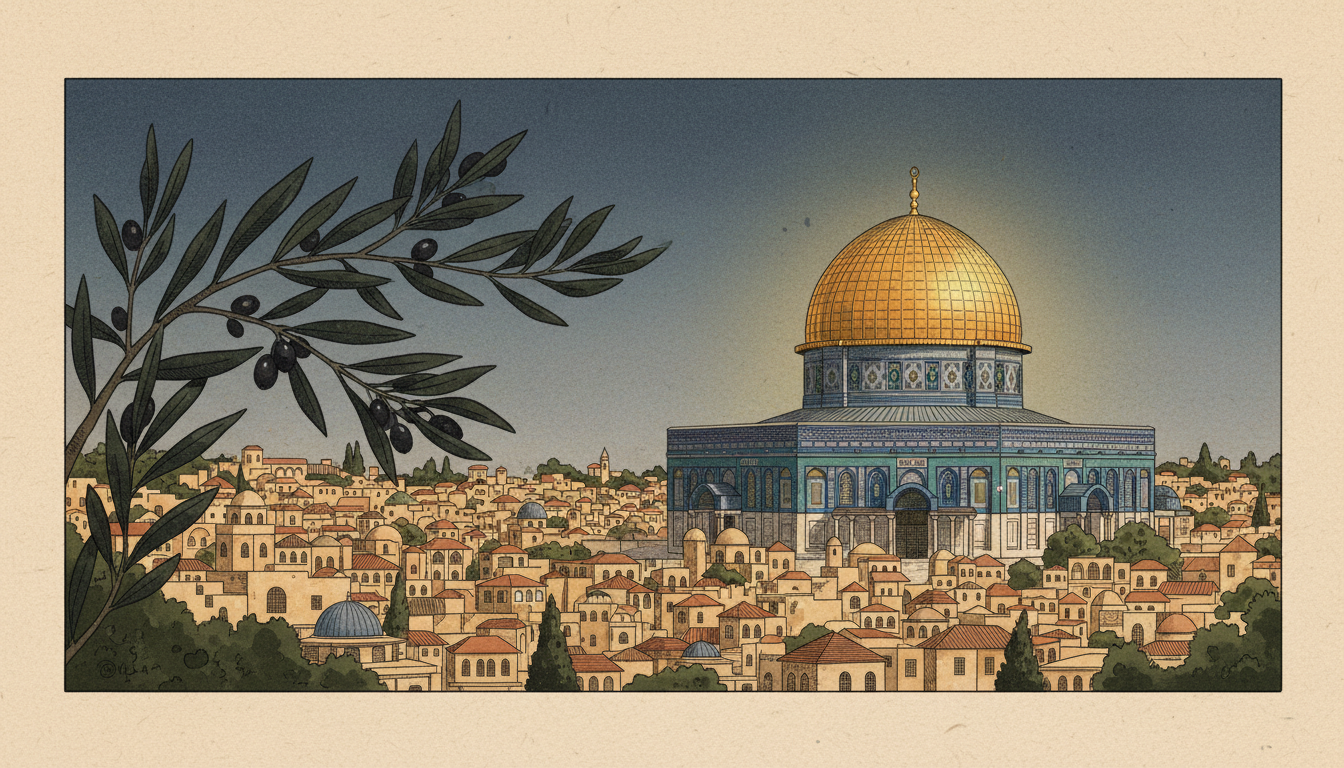
“The Prophets Home, the Golden Dome”View this chapter’s poem ↗
Jerusalem is the city of the Prophets. It is where countless Messengers of God lived, prayed and walked, from Dāwūd and Sulaymān to ʿĪsā, peace be upon them. The Qur’ān recalls how Allah brought Ibrāhīm and Lūṭ to the land He had blessed. It was to al-Masjid al-Aqṣā that the final Prophet ﷺ journeyed on the night of the Isrāʾ. Jerusalem is the spiritual heartland of the Abrahamic tradition. [1] [2]
“The Golden Dome” is a direct reference to Qubbat al-Ṣakhrah, the Dome of the Rock, completed in 691–692 CE. Its golden dome has become a symbol of Jerusalem and the Islamic presence in the Holy Land, linking the prophetic legacy with the civilisation that grew around it. [3]
Jerusalem belongs first and foremost to the Prophets and their final message, Islam.
“Tell Greece, tell Rome at glinting gloam”View this chapter’s poem ↗
“Tell Greece, tell Rome” is a challenge addressed to the heirs of the great empires that once ruled or influenced the region. Go ahead and ask your predecessors, the philosophers of Greece and the Caesars of Rome, what happened to their empires in Jerusalem.
“Gloam” means twilight or dusk. “Glinting” suggests the golden dome catching the last rays of sunlight. The empires, too, lived to see their dusk. Yet through it all, Jerusalem remained the Prophets’ Home.
Empires rise and fall (Greece, Rome, Byzantium, the Crusaders, the Ottomans, the British, and now the modern settler project), and the Golden Dome looks out over the city today. Empires come and go, but the sanctity of this land, the heirs of the prophets and the truth it represents endure.
“At Quds … for hearts so pure,View this chapter’s poem ↗
Jerusalem till end endure.”
Very early in the poem, Jerusalem is introduced not merely as a sacred place, but as a land fitted to pure hearts. The language anticipates a theme developed later in the poem: al-Quds is bound to the Arabic root q-d-s, the language of holiness and purity. Here, however, the emphasis is not simply on the purity of the place, but on the servants whom Allah gathers towards it.
When ʿAbdullāh ibn Ḥawālah رضي الله عنه asked where he should be when the Muslims would become divided into armies in al-Shām, Yemen and Iraq, the Prophet ﷺ directed him towards al-Shām and said that it is Allah’s chosen land, to which He gathers His chosen servants. The Arabic expression is especially striking:
يَجْتَبِي إِلَيْهَا خِيرَتَهُ مِنْ عِبَادِهِ
“He gathers to it His chosen servants.” [13]
The report speaks of al-Shām broadly, not Jerusalem alone. Yet al-Quds lies at the sacred heart of that blessed geography. The verb yajtabī carries the sense of choosing and selecting. The land therefore becomes not merely a destination, but a place associated with divine selection.
A second report speaks of “migration after migration” and says that the best of the people of the earth will remain closest to the place of Ibrāhīm’s migration. The report has been graded differently by hadith scholars, but it preserves an old and powerful association between later tribulation and the land to which Ibrāhīm migrated. [14]
The Qurʾān itself describes Ibrāhīm and Lūṭ being delivered “to the land which We had blessed for all worlds”, classically identified with al-Shām. [15] Thus the path of the Patriarch becomes a pattern: when faith is tested, some servants migrate not simply to save their bodies, but to protect their īmān.
There is also a movement in the opposite direction. The land does not merely receive hearts that are pure; through its trials it can purify those who remain faithful within it. The Qurʾān speaks of Allah testing the believers “so that Allah may purify those who believe”. [16] Jerusalem has rarely permitted comfortable indifference. Its history of siege, loss, occupation, steadfastness and struggle can become a form of tamḥīṣ: a furnace in which what is genuine is separated from what is merely claimed.
So the line carries two movements at once: the pure are drawn towards the land, and the land, by Allah’s permission, purifies those who remain faithful within it. We will return to the language of purity later in the poem. Here it first appears quietly, as part of the reason Jerusalem can pass through the hands of empires while remaining, until the end, the Prophets’ Home.
“Each inch a tale each span a song,View this chapter’s poem ↗
Of nations gone of time so long.”
Every inch of this blessed land carries a story. The poem draws its image of the handspan from a saying that the medieval geographer Yāqūt al-Ḥamawī attributes to ʿAbdullāh ibn ʿAbbās رضي الله عنهما in his entry on Bayt al-Maqdis.
“The prophets built Bayt al-Maqdis and the prophets lived there. There is not a handspan in it where a prophet did not pray or an angel stand.” (A saying attributed to Ibn ʿAbbās, translation of meaning.) [4]
Every span of Jerusalem has witnessed the footsteps of prophets, the standing of angels, and the rise and fall of nations.
From the time of Ibrāhīm and Sulaymān to the final revelation, the land has absorbed the prayers, struggles and histories of countless generations.
“When Adam lay its stones so bare,View this chapter’s poem ↗
And angels cleansed the mount and square.”
The line about Ādam follows one of the classical accounts of who first laid the foundations of al-Masjid al-Aqṣā. In his commentary on al-Bukhārī, Ibn Ḥajar al-ʿAsqalānī considers several accounts and gives weight to the tradition that Ādam laid its foundations after building the Kaʿbah in Makkah. [5]
The hadith of Abū Dharr, recorded by al-Bukhārī and Muslim, gives us the order of the two sanctuaries. Its words concern the interval between them and leave the builder unnamed. Abū Dharr asked the Prophet ﷺ which mosque was established first on earth.
“Al-Masjid al-Ḥarām.” He asked which came next. “Al-Masjid al-Aqṣā.” And how much time came between them? “Forty years.” (Hadith of Abū Dharr, translation of meaning.) [6] [7]
“Angels cleansed the mount and square” imagines the site being purified and prepared for worship. The poem sets two features of Jerusalem’s landscape beside one another.
“The mount” refers to the Mount of Olives, Jabal al-Zaytūn, the ridge immediately east of the Old City. Christian tradition associates it with the ascension of Jesus. The Qur’ān affirms that Allah raised ʿĪsā to Himself without naming the place. [8] [9]
“The square” refers to al-Ḥaram al-Sharīf, the Noble Sanctuary inside the Old City. This walled esplanade covers approximately 144,000 square metres. The Qiblī prayer hall, the Dome of the Rock and the open spaces between them all stand within the precinct of al-Masjid al-Aqṣā. [10]
“For saints to come, the earth prepare,View this chapter’s poem ↗
For Abraham, to rest right there.”
The land of Palestine was divinely prepared and sanctified from the earliest times as a resting place and sanctuary for the Prophets and righteous servants of Allah.
“For Abraham, to rest right there” refers to Ibrāhīm ﷺ, the father of the Prophets. Here the poem’s gaze travels south from Jerusalem to Hebron, al-Khalīl, the city that bears his title, the intimate friend.
The Ibrāhīmī Mosque stands over the cave traditionally revered as the burial place of Ibrāhīm and his family. The account in Genesis names Abraham and Sarah, Isaac and Rebekah, and Jacob and Leah in connection with the cave. Their names explain why one place in Hebron carries so much of a family’s story. [11] [12]
This line connects the preparation of the land in the opening couplets to the resting place traditionally associated with the intimate friend of Allah. The next lines turn from the place where Ibrāhīm rests to the people who claim to follow his way.
References
1. Qur’ān 21:71, Ibrāhīm and Lūṭ in the blessed land
2. Qur’ān 17:1, the Night Journey to al-Masjid al-Aqṣā
3. The Metropolitan Museum of Art, the Dome of the Rock and its completion in 691–692 CE
4. Yāqūt al-Ḥamawī, Muʿjam al-Buldān, entry on al-Maqdis, vol. 5, p. 167
5. Ibn Ḥajar al-ʿAsqalānī, Fatḥ al-Bārī, commentary on al-Bukhārī 3366
6. Ṣaḥīḥ al-Bukhārī 3366, Abū Dharr on the two sanctuaries
7. Ṣaḥīḥ Muslim 520a, the interval between the two mosques
8. Acts 1:9–12, the ascension account and the Mount of Olives
9. Qur’ān 4:158, Allah raising ʿĪsā to Himself
10. Jordanian-Palestinian agreement of 2013, description and area of al-Masjid al-Aqṣā
11. UNESCO World Heritage Centre, Hebron/Al-Khalil Old Town
12. Genesis 49:29–50:14, the family burial cave and Jacob’s burial
13. Sunan Abī Dāwūd 2483, al-Shām and Allah gathering His chosen servants to it
14. Sunan Abī Dāwūd 2482, the report concerning later migration and the place of Ibrāhīm’s migration; its grading has been discussed among hadith scholars
15. Qurʾān 21:71, Ibrāhīm and Lūṭ delivered to the blessed land