At the bedside of the man whose name a nation would carry, his sons had to answer a question their ancestry could never answer for them.
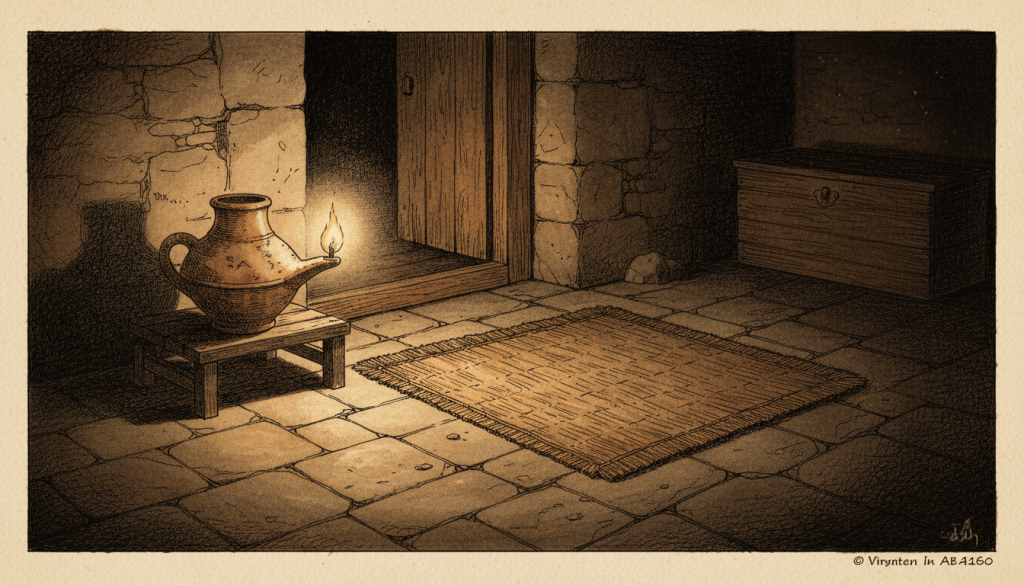
The next couplets move from Ibrāhīm to Yaʿqūb.
“Recall Jacob in Isaac’s stead,View this chapter’s poem ↗
At death his kind around his bed.
In Palestine, glancing ahead.
Which creed shall you preach to and spread?
They said in truth, ‘as you foresaid’,
The Lord Allah, as Muslims bred.”
This is a poetic retelling of one of the most decisive Qur’anic scenes against false claims of prophetic inheritance. Yaʿqūb AS, Jacob, son of Isḥāq, son of Ibrāhīm, stands in the great Abrahamic line. From Ibrāhīm comes Isḥāq, from Isḥāq comes Yaʿqūb, and from Yaʿqūb comes Banī Isrāʾīl, among whom arose a long line of prophets culminating in ʿĪsā AS.
From Ibrāhīm also comes Ismāʿīl AS, from whose line comes the final Messenger ﷺ.
Yaʿqūb is also called Isrāʾīl. Ibn Kathīr, commenting on “O Children of Israel”, identifies Isrāʾīl as the Prophet of Allah Yaʿqūb AS. He frames the address as a call to the children of that righteous servant to imitate their father in following the truth. Ibn Kathīr also records an explanation from Ibn ʿAbbās that compares the name Isrāʾīl to ʿAbdullāh, the servant of Allah. [1]
This matters because the Qur’anic title Banī Isrāʾīl has layers. In one sense, it refers to the blood descendants of Yaʿqūb. In another religious and moral sense, the worthiest heirs of Isrāʾīl are those who preserve the creed of Isrāʾīl: submission to the One God. The Qur’an itself repeatedly moves the argument away from racial inheritance and back to covenantal fidelity.
The question comes from Sūrat al-Baqarah.
“Or were you witnesses when death approached Jacob, when he said to his sons: ‘What will you worship after me?’ They said: ‘We will worship your God and the God of your fathers, Abraham, Ishmael and Isaac, One God, and to Him we submit.’” (Qur’an 2:133) [2]
Al-Qurṭubī explains that this verse rebukes Jews and Christians who falsely attributed their later religious identities to Ibrāhīm and Yaʿqūb. Were you present when Yaʿqūb gave his final counsel, such that you can claim knowledge of it? [3]
There is also a subtle linguistic point in Yaʿqūb’s question.
“What will you worship after me?”
He says mā, meaning “what”, not man “who.” Al-Qurṭubī explains that Yaʿqūb was testing them. [3]
Had he said “who”, it would already suggest guidance toward the true object of worship. By saying “what”, he allowed for the possibility of false worship, since many objects worshipped besides Allah were lifeless things, including idols, fire, the sun and stones. His question therefore examines not merely their inherited identity, but the reality of their worship.
The answer of his sons is the centre of the scene.
“One God, and to Him we submit.” [2]
Thus, the passing patriarch is not passing down a land deed, but passing on the only inheritance that ultimately matters: tawḥīd.
The couplets place Palestine within the continuity of prophetic Islam: Ibrāhīm, Isḥāq, Yaʿqūb, the children of Yaʿqūb, and later ʿĪsā AS, bound not by Zionist claims of blood and soil, but by the creed of submission to Allah.
The Qur’an itself describes Ibrāhīm and Lūṭ being delivered to the land Allah blessed for the worlds. Classical explanations identify this blessed land as al-Shām, including Palestine. [4]
“In Palestine, glancing ahead” places the couplets within the poem’s history of the Holy Land. The Qur’ān does not locate Yaʿqūb’s deathbed. In the biblical account, he dies in Egypt and his sons carry him back to Canaan for burial. The land where a man asks to be buried and the charge he leaves his children are two different inheritances. [2][5][6]
Yaʿqūb’s final concern was expressed in the question he put to his sons.
“What will you worship after me?” [2]
Prophetic inheritance is first and foremost the inheritance of knowledge, tawḥīd, submission and guidance. Abū Dāwūd records the words of the Prophet ﷺ.
“The scholars are the heirs of the Prophets. The Prophets did not leave behind dinars or dirhams. They left knowledge. Whoever takes it has taken an abundant share.” [7]
The Qur’an shows us Yaʿqūb in his true station, a Prophet whose final breath was consumed by the question of worship. His last concern was not land and bloodline, but whether his children would remain upon the worship of the God of Ibrāhīm, Ismāʿīl and Isḥāq.
Palestine's worthy heirs are those who preserve the creed of the prophets who walked its soil.
References
1. Ibn Kathīr on Qur’ān 2:40, Yaʿqūb and the Children of Israel
2. Qur’ān 2:133, Yaʿqūb’s question and his sons’ reply
3. Al-Qurṭubī on Qur’ān 2:133, including mā and the use of ‘fathers’
4. Ibn Kathīr on Qur’ān 21:71, the blessed land
5. Genesis 49:29–33, Jacob’s burial instructions
6. Genesis 50:12–14, the journey to Canaan and return to Egypt