
From the moment Isrāʾ chose Ḥudhayfa, she never left his side. Like the women of the first generation, she carried loyalty as a covenant: with you always, until death…and she kept it.
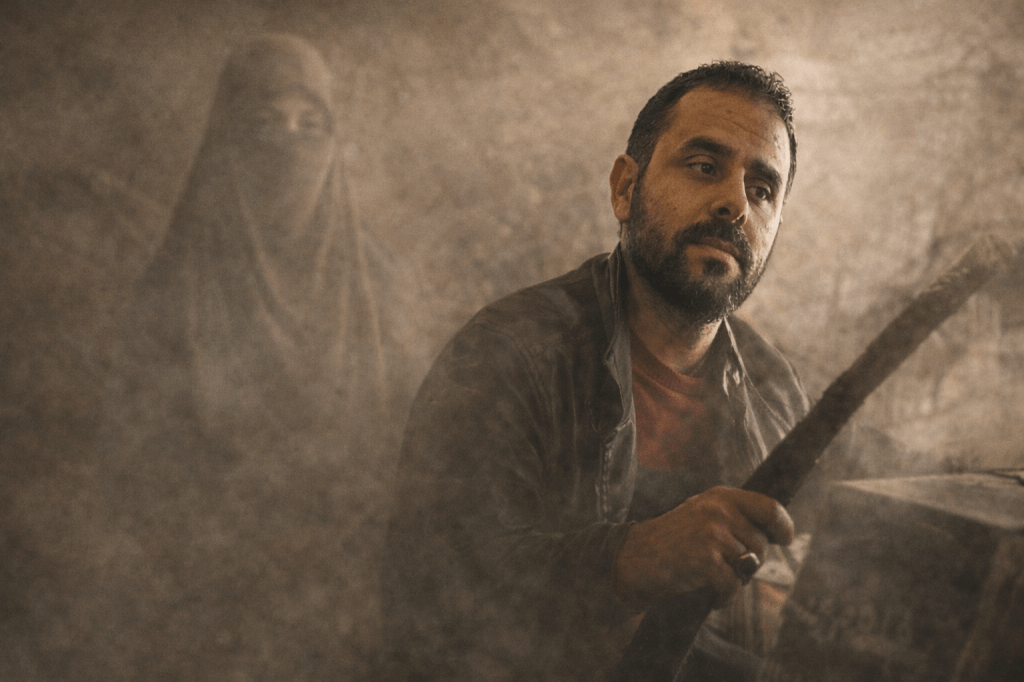
Al Jazeera Net. (2026). [Who Was the Woman Behind the Masked Man] by Yusrā Al-Aklūt – English translation by the author.
Isrāʾ held a leaflet dropped by Israeli aircraft that revealed the identity of the resistance’s spokesperson and offered a financial reward for information about him.
With a trembling hand and pair of small scissors, she trimmed the edges of the picture, then hung it on the peeling wall of her narrow room, whose area did not exceed 12 square meters.
It was the image of the man whom people knew as a military spokesperson, Abū ʿUbayda. The same man who Isrāʾ knew as her beloved Ḥudhayfa.
Her young son, Yamān, watched her in silence. He stood transfixed by the picture as though it were the last thread binding him to his father, whispering, “Baba… Baba.” Isrāʾ responded, “Remember him, Yamān,” carrying a heart that melted with longing to touch the face that had been absent from her for months.
Beside the picture, she hung supplications in the hope that they might calm her fear, for everything around her was terrifying in the absence of the safety she once found in Ḥudhayfa’s arms. Her family was not there to support her, nor were there mobile phones to carry to her any news.
Thus, she came to know nothing of the world, and the world knew nothing of her. This may appear natural for the wife of a first-rank fugitive, against whom Israel had mobilised its full array of eyes and surveillance systems to track his every trace.
The Ceasefire Encounter
After more than a year of his absence and her aching for his voice and presence, the ceasefire came into effect and the dividing barrier between the north and south of the Strip was lifted. Boundaries dissolved, fear receded, and her heart was finally quenched by what it had long yearned for.
Ḥudhayfa was among the first to cross and arrive in the southern Strip, laden with gifts for his four children. In his palm he carried a special gift for Isrāʾ: a heavy gold earring, that he gifted her for her patience during his long absence.
That gift was a slender thread of warmth, extending to her from the love she had been deprived of during the long months of war, rekindling in her heart the first spark that had been lit twenty years earlier, when she was just seventeen. She completed her secondary education under his care, then went on to finish a university degree in journalism and media, excelling in her studies.
With You Until Death
From the moment Isrāʾ met Ḥudhayfa, she never left his side. And despite the return of the war, she did not allow herself to live the bitterness of separation from him once again. Her unspoken message to him at every moment was: “With you forever, until death,” and, indeed, she fulfilled her promise.
The Sole Survivor in the House of Abū ʿUbayda
Nine months after that moment, Aljazeera met the sole survivor of Abū ʿUbayda’s family, which had consisted of six members.
Extending his injured leg, weighed down by the heavy platinum rods implanted in it, with a pale face bearing the burden of sleeplessness and a mind that had not yet grasped the enormity of what he had endured, sat 18-year-old Ibrāhīm.
Ibrāhīm, the sole survivor and the eldest son of the masked man, was one of four children: two daughters and two sons, Liyān (15), Minnatullāh (12), and Yamān (7).
“How did you emerge alive from this crushing attack?” The Aljazeera journalist asked. He smiled and replied, “I wish I knew the answer.”
Many scenarios had long haunted Ibrāhīm’s mind: that he alone would be martyred, or that his father alone would be martyred, or that they would all be martyred together. He never imagined the story would end this way, nor did it occur to him that a vision he had seen on the night they were targeted, of firing five shots into the air, meant that five souls would ascend to the heavens, leaving him alone.
The Final Moments
Ibrāhīm recalls the moment when his life was turned upside down, saying:
“The ‘ṣawmī’ eggplant tray was the last meal we gathered around, and my father was lighting the firewood with his own hands so we could eat.”
After they gathered to perform the ʿAṣr prayer, Isrāʾ picked up her copy of the Qurʾān and began reciting her daily portion from Sūrat al-Baqarah, while Yamān clung to his brother Ibrāhīm, holding his hand. At that moment, bombs rained down upon their heads. The pressure of the blast scattered them in every direction. Yamān was flung several meters away.
Ibrāhīm did not lose consciousness, but he was unable to move due to his severe injury. He began calling out to Yamān: “Say, ‘I bear witness that there is no god but God,’ my beloved.” But he did not respond, and Ibrāhīm realised that he had been martyred.
He continued calling out, but no one answered, and he became certain that his vision had been fulfilled: all five members of his family had ascended, and he remained alone.
Ibrāhīm told Al Jazeera:
“We were aware of the magnitude of the risk of being with our father, yet a strange sense of security enveloped us when he was with us.”
He paused briefly, as if reliving the emotion, then continued:
“I was surprised by the state of tranquillity we were in. During the period when we were separated from him, I was very afraid.”
Ibrāhīm recounted what his father used to say when the bombardment around them intensified, consoling his children and calming their fears:
“What is the worst that can happen? That we die together? Death is not painful, and welcome indeed is the meeting with God.”
A Qurʾānic Family
Isrāʾ and her husband raised members of their family to become memorisers of the Qurʾān; three of them completed its memorisation. Isrāʾ took advantage of the war period and her children’s confinement to their places, supervising the completion of her son Ibrāhīm’s memorisation during the first month of the war. Liyān completed hers midway through the war, and Minnatullāh completed it after beginning it in full during the war.
Ibrāhīm describes his mother, saying:
“She never abandoned the night prayer, and we would hear her supplicating for us and for our parents every night. She urged us to recite the morning and evening remembrances and to perform prayer on time. She was strictly against anything that contradicted our faith.”
During the war, Abū ʿUbayda spoke to his children only in whispers, fearing detection by surveillance aircraft. In voices barely audible, he reflected with them on the Beautiful Names of God, contemplating two names each day, and quietly instilling in them the creed he had lived and studied through every conversation and circumstance.
Ibrāhīm began to understand his father’s status and military designation only a few years prior to the war. His mother had begun instructing her children to take security precautions to protect the family’s safety, such as using special secure phones with covered cameras and activated non-tracking features.
Among the earliest instructions given to the children of Abū ʿUbayda was absolute denial, a security measure reinforced after the occupation published his name and image. Ibrāhīm explains:
“Whenever I was asked about my name, I denied it. Even during my injury, while lying in a hospital bed, I denied being related to him.”
Since Abū ʿUbayda’s appointment as military spokesperson, he had regularly changed his place of residence. During periods of calm, the family lived with relative normalcy in their movement and communication; during times of war or escalation, however, they adopted strict and heightened security measures.
Ibrāhīm says his father survived several assassination attempts, including an attempted kidnapping years earlier. The last, and most extraordinary, occurred during the war, when occupation soldiers were present in the very building where Abū ʿUbayda was hiding. He remained besieged there for fourteen days, prepared to confront them, yet they ultimately withdrew without harming him. Ibrāhīm recalls:
“My father told me this story. It was a great Divine Favour for him to be in their stronghold while God blinded their eyes to him.”
As for his father’s relationship with his mother, Ibrāhīm describes it as far from ordinary. A type of singular bond rooted in mutual respect and profound understanding. “I was always struck by the harmony between their thoughts,” he says.
This portrayal is echoed by Abū ʿUbayda’s mother, who sat beside her grandson during the interview. She told Aljazeera that throughout the twenty years in which Isrāʾ was married to Ḥudhayfa, she never once heard a complaint from either of them. Rather, the atmosphere of respect between the two was striking within the family.
She explains that her son married Isrāʾ in a traditional arrangement, following the advice of a friend who was married to Isrāʾ’s sister. He spoke highly of the family, and of the young woman’s composure and level of religiosity, qualities he felt were well suited to his circumstances.
ʿImād, Isrāʾ’s brother, added that his sister did not hesitate to accept Abū ʿUbayda’s proposal, despite his position as military spokesperson at the time. Her moral commitment to the resistance made Ḥudhayfa’s request a trust she considered invaluable and impossible to refuse. She bore the weight of that responsibility with resolve and competence, without seeking approval or praise from those around her.
Her brother describes her as a woman in the mould of the female Companions, never complaining about her way of life or the restrictions imposed upon it. She was intensely reserved, maintaining silence about anything that might endanger her husband or expose his secret.
This disposition was familiar to her friends, who studied alongside her and accompanied her through her university years. They were later stunned, upon her martyrdom, to learn that she had been the wife of the Qassam spokesperson.
They unanimously told Aljazeera that her speech was sparse and measured, her relationships limited, and that she did not mix widely. One of her friends, Khulūd (a pseudonym), said:
“God honoured me with her companionship. I did not know she was the wife of the spokesperson until after her martyrdom, even though we met many times. She never once spoke of him in our presence.”
According to her friends, Isrāʾ embodied the model of the Muslim mother and true educator: firm with her children in matters of religion, fiercely protective of her husband’s secrets, exceptionally calm, humble, and reserved, as though her presence itself radiated tranquillity and serenity.
Another friend, Ālāʾ, said:
“She was like a gentle breeze, soft and kind. She lived and was martyred without harming anyone or leaving a single bitter memory in anyone’s heart.”
And despite her reserve, Isrāʾ was no different from her peers; her circumstances and her marriage to Abū ʿUbayda did not diminish her ambition or her vitality.
Follow Sarim.blog telegram channel for instant updates and more… https://t.me/SarimBlog
Reference:
Al Jazeera Net. (2026). [Who Was the Woman Behind the Masked Man] by Yusrā Al-Aklūt [English translation by the author]. Al Jazeera. https://aja.ws/iqc69h

 SarimBlog
Jazakallahu khairan for the translation.
LikeLike