The question every Christian should be asking is not why Islam resists reform, but why Christianity required it to survive, and why Islam is now attacked for preserving the very principles the ‘Christian West’ movement claims it wishes to revive.
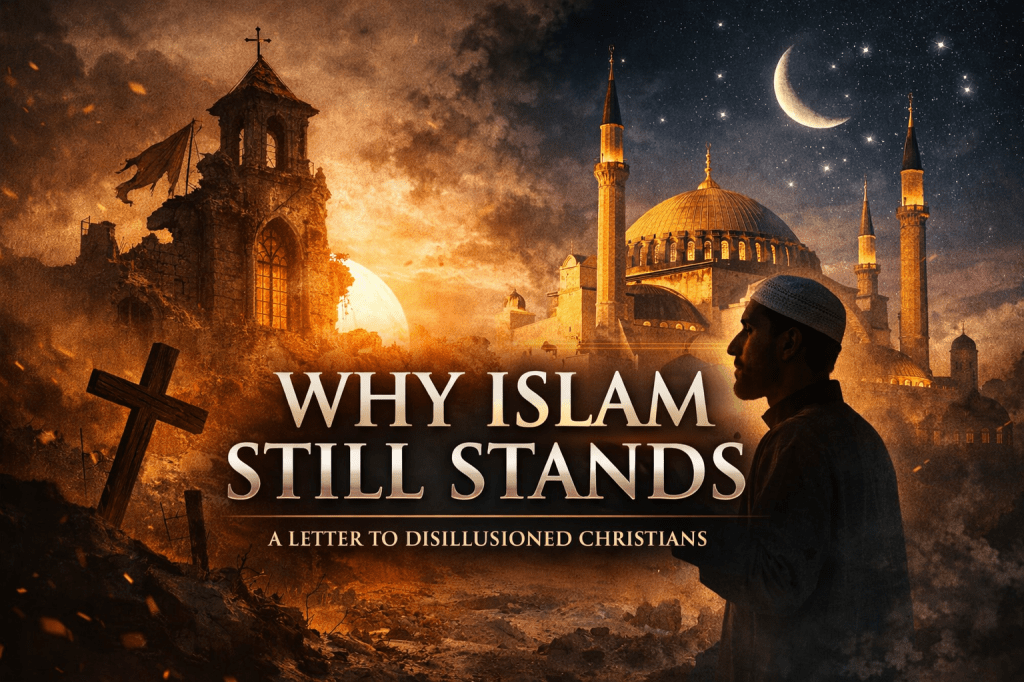
The Christian Identity
Across the Western world, Christianity is re-emerging in public discourse. But rather than a faith in practice, it is invoked as culture, heritage, or civilisational branding, particularly prevalent among the political ‘right’. These movements speak of a ‘Christian West’ while remaining uneasy with Christ’s own teachings, embarrassed by scripture, and even hostile to Divine Law. Though Christianity is indeed being revived, the reasons are not because it is believed to be true, but because it has become a useful rallying cry for the disillusioned.
Almost in the same breath, Islam is attacked precisely because it has refused the same transformation, refusing to be reduced to folklore or mere symbolism.[1] Unlike Christianity, Islam has never apologised for God, never agreed to depart from normative belief and practice, and never consented to survive only by exception.
This article is precisely for those Christians who admire the seriousness and structure of religion, feel the hollowness of Secular Liberalism, and who recognise that Christianity (at least as it exists today) has been hollowed out for survival, rather than pertinence.
The Selective Fear of Scripture
Modern hostility to Islam is often framed around a narrow set of issues: law, gender, sexuality and punishment.[2] These are presented as uniquely Islamic declarations and ‘proofs’ that Islam is incompatible with modern life. Yet the same or even far more pronounced moral contentions appear in the Hebrew Bible and the New Testament.
Christian Scripture speaks plainly about gender roles, sexual morality, obedience, punishment, and authority, including patriarchal authority. Historically, these texts shaped Christian law, social structure, and moral norms for centuries. The content of Scripture has not significantly changed, but still today, while the ‘Christian West’ brandish bibles and crosses, they still lack the confidence to affirm these passages.
Where Christianity now explains away its firm passages, relegating them to history, metaphor, or irrelevance, Islam insists that Divine Revelation is not embarrassed by the passage of time. The asymmetry is that Islam is interrogated for believing what it teaches, while Christianity is spared scrutiny precisely because it no longer does.
Authority Without Apology
At the heart of the modern religious crisis is authority. Secular Liberalism rejects authority altogether, replacing it with personal autonomy and subjective morality. Contemporary Christianity, caught between revelation and contemporary relevance, often adopts the same posture, retaining religious language while emptying it of Divine Command. ‘Christ is King’ only in posturing and statement, but on the ground, the way he lived his life remains largely irrelevant.
Islam takes a different path. It unabashedly begins from a premise that modernity finds offensive: that God has the Right to Command, and human beings have the obligation to obey. Moral law originates in revelation. It does not come from human consensus, nor does it evolve with cultural preference.
Islamic law is often misunderstood because its aim is not punishment but order. And though it indeed claims moral ascendancy above every system and ideology, this is not grounded in any notion of Muslim exceptionalism or the perfection of its followers, but in the weight of Divine Revelation and the corresponding coherence of its principles.
Its highest aims are the preservation of faith, life, intellect, family, and property. Its most severe penalties are surrounded by conditions so stringent that they function as moral boundaries or firm deterrents, rather than instruments of violence.
The Family: Stewardship of Suspicion?
Few areas expose the modern rupture more clearly than the family. In contemporary discourse, shaped largely by feminist theory as it has been absorbed within the modern West, fatherhood is often treated with suspicion, authority with hostility, and hierarchy with fear, frequently equated with authoritarianism. Religious structures that affirm paternal responsibility, and indeed greater accountability before God, are consequently recast as systems of domination.
Christian Scripture itself contains strong affirmations of male leadership within the household, female modesty, and ordered roles. These affirmations were normative for most of Christian history. The modern retreat from these teachings has not produced stronger families, but weaker, broken ones, fractured homes, absent fathers, emasculation and confusion passed down for generations.
Islam does not approach the family as a site of power struggle, but as a trust.[3] Authority is inseparable from responsibility and leadership is accountable before God. The obedience due of one is counter-balanced by the obligation due upon the other. Marriage is not a necessary evil but a sign of mercy and parenthood is sacred.
Morality Without God
Many who appeal to a ‘Christian West’ do so while rejecting the theological foundations that once sustained it. The language remains, but its authority is gone. Good and evil in the Western World have become matters of sentiment, law is a reflection of whoever has the power to create or enforce it, and ‘rights’ replace responsibilities.
Islam refuses this separation,[4] and grounds each and every one of its claims in metaphysical truths. It argues that if God exists, His Will matters. If He Commands, obedience is not optional. And if He Judges, morality cannot be endlessly renegotiated by the ever-changing appetites and sensibilities of man.
This is deeply unsettling to the modern mind, but compelling to those who sense the disillusionment of the modern world.
Why Christianity Could Not Hold the Line
Christianity’s difficulty in sustaining moral and theological authority under modern conditions is primarily down to its collapse of structure. The historical intertwining of church and empire, followed by the shock of the Enlightenment, the rise of higher biblical criticism, and the fragmentation of ecclesial authority after the Reformation left Christianity without a single, preserved reference point capable of resisting external intellectual pressure.
From as early as the first century, scripture became subject to historical relativisation, doctrine to private interpretation, and moral teaching to cultural negotiation, exacerbated by the first adoption of the Christian faith by the Pagan Roman Empire in 312CE which favoured texts that aligned with prevalent Greco-Roman theology for better ‘mass appeal’. After the Reformation, the biblical tradition completely ceded interpretive unity, thus lacked the internal mechanisms required to absorb modernity without dissolving into contradiction.
Why Islam Has Not Reformed
Islam has not undergone a reformation because it does not suffer from the same internal contradictions. Its scripture is preserved, its theology is intact and its law is continuous, surviving the test of time, place and culture. Islam has never required political authority, or cultural domination, be it ‘Greek’ or ‘Latin’ to legitimise it. And indeed, Islam’s centre of power, unlike Christianity, very often shifted from one place to another, between its two geographic extremities.
Where Christianity fragmented under the pressure of modernity, splintering into competing interpretations on its very fundamentals, Islam retained a unified framework. Its diverse jurisprudence was built upon shared foundations, disagreement operated within the boundaries of consensus and flexibility never came at the cost of submission to God.[5]
An Invitation
To the sincere torchbearers of the ‘Christian West’ movement, this is an invitation to intellectual and spiritual honesty.
Islam does not claim its teachings are modern. It asks whether truth is obligated to submit to modernism. In an age where Christianity survives by exception and secularism by denial, Islam remains what it has always claimed to be: submission to the One Who Commands, the One Who Judges, and the All-Merciful Creator of you and I.
The question every Christian should be asking is not why Islam resists reform, but why Christianity required it to survive, and why Islam is now attacked for preserving the very principles the ‘Christian West’ movement claims it wishes to revive.
Instead, if you long for a faith that speaks with authority, commands without embarrassment, and submits without contradiction, Islam is the only enduring path where submission to the One God has been preserved whole.
References:
[1] See Qur’an 2:105.
[2] See 1 Corinthians 11:5–10; 1 Corinthians 14:34–35; Ephesians 5:22–24; 1 Timothy 2:11–15.
[3] Qur’an 30:21; Qur’an 2:187.
[4] Qur’an 24:30–31; Qur’an 33:59.
[5] On continuity and consensus (ijmāʿ) in Islamic law, see classical Sunni jurisprudential literature.

 SarimBlog
Assalamu alaykum wa rahmatullahi wa barakatuhu and jazakallahu khairan for the mail. Despite your excellent article, Sir, I must say with regret – and as a Muslima- that I think differently: Islam is not ONLY what literalists took hostage (Alhamdulillah!). Kind regards
LikeLike