
Despite its revelation in Arabia, the unwavering support, resilience, and equilibrium essential for bearing the weight and strain of Islām are found in Palestine. As such, Palestine stands as Islam’s steadfast pedestal, its resilient pillar, and its load-bearing capital.
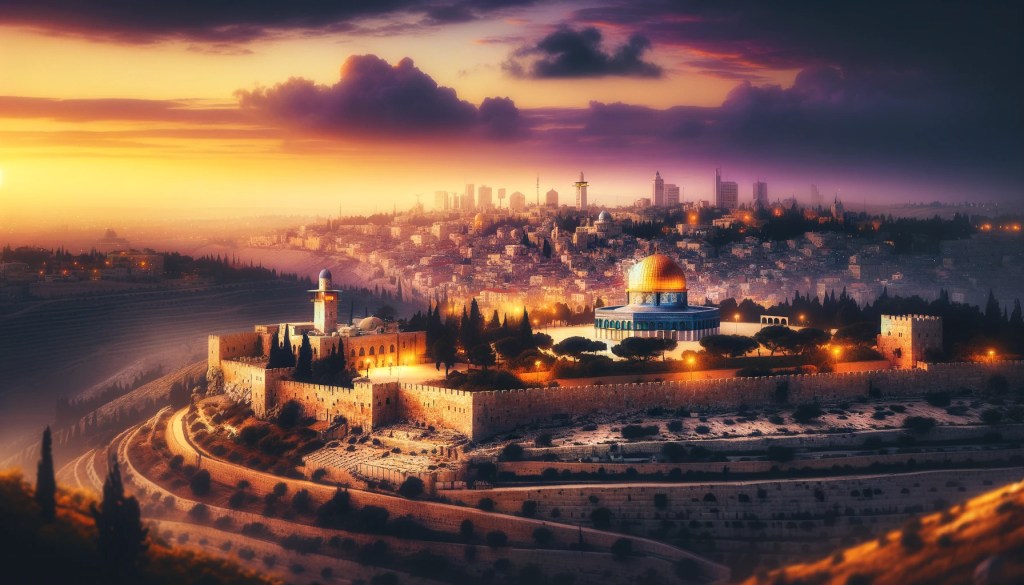
All Abrahamic traditions hold deep reverence for Palestine, often referred to as God’s ‘Promised Land’. Within our tradition, there are numerous names for this sacred land, including ‘Baitul Maqdis‘ or the ‘Home of Purity’, ‘Al Quds al Sharif‘, ‘Uwla al Qiblatayn‘, ‘Madinat Dawud’ (the City of Prophet David), ‘al Ribāt‘ (the Outpost), Iliyā’, and the Land of Isrā (the Night Journey of Ascension), among others. Similarly, previous scriptures contain over 70 names for Jerusalem, such as the ‘Faithful City’, the ‘Paragon of Beauty’, and the ‘Oasis of Justice’.
In the Hadith:
“It is Allah’s chosen land, to which his best servants will be gathered.”1
It is therefore entrusted to the chosen of Allāh, and to those who can uphold and impart principles of objective Truth and Justice. It serves as the sceptre of global authority; if it is in the hands of the servants of Allāh, then it signifies a world where justice has prevailed, and conversely.
This is the reason why the ongoing battle for Palestine continues to draw the attention of people from all corners of the world who represent both justice and injustice. It serves as the convergence point for these two ideologies – the land where injustice must be ultimately vanquished. Al Quds, the city where purity, from its name, and truth triumph over impurity and falsehood.
Throughout the lifetime of the Messenger sala Allāhu ‘alayhi wasalam, he instilled a deep affection for Palestine (the heart of al Shām) in the hearts of his companions and guided their ambitions toward this region. From the inception of the message, the companions were being readied to assume the role of the ultimate and enduring custodians of this land.
Emphasising the exclusive nature of the land, the Prophet salla Allāhu ‘alayhi wasallam says:
“Tuba is for al Shām. So we said: ‘Why is that O Messenger of Allāh?’ He said: ‘Because the angels of al Rahmān spread their wings over it.’“2
Its Exclusive People
And on the exclusivity of its people he said:
“It will turn out that you will be armed troops, one is Syria, one in the Yemen and one in Iraq. Ibn Hawālah said: ‘Choose for me, Messenger of Allāh, if I reach that time.’ He replied: ‘Go to al Shām, for it is Allāh’s chosen land, to which his best servants will be gathered, but if you are unwilling, go to your Yemen, and draw water from your tanks, for Allāh has on my account taken special charge of al Shām and its people.’”3
There is a profound nuance in this Hadith regarding the notion of victory. The Hadith implies the existence of ‘troops’, implying a need for such forces, being a land regularly fraught with hardship and targeted by its enemies. In today’s context, we observe this reality.
One might legitimately ask how Allāh has assumed special responsibility for a region and people enduring a constant cycle of suffering at the hands of the world’s most heinous oppressors. This certainly brings out the authentic concept and true paradigm of victory – which is the unwavering religious commitment despite such suffering. Allāh has assumed responsibility for the hearts and spiritual continuity of the people of al Shām.
Its Exclusive Spiritual and Intellectual Feature
And on its continuous and central spiritual and intellectual feature. The Messenger sala Allāhu ‘alayhi wasalam said:
“As I was asleep, I saw (in a dream) the pillar of the book, being carried away from beneath my pillow. So, I suspected that it would be taken away, so I followed it with my gaze and it was placed in al Shām. Indeed, Iman during the times of tribulation will be in al Shām.”3
Palestine emerges as the sacred ground where Islam is ultimately safeguarded and upheld, both by place and people, amid a world embroiled in tribulations, Kufr, and moral decay. The people of al Shām, emanating from Palestine as the central point, are the ultimate guardians of the message. They are not the book itself, but the pillars that carry its payload. Despite its revelation in Arabia, the unwavering support, resilience, and equilibrium essential for bearing the weight and strain of Islām are found in Palestine. As such, Palestine stands as Islam’s steadfast pedestal, its resilient pillar, and its load-bearing capital.
The eventual arrival of Imān in al Shām establishes it as the ultimate sanctuary for the faithful, where both their physical and spiritual well-being are safeguarded. In the Hadith:
“A fire will emerge from Hadramawt -before the Day of Judgement- to gather the people. They said: ‘O Messenger of Allah! What do you order us to do?’ He said: ‘Go to al Shām.‘”4
The region of Palestine demonstrates enduring religious vitality and its spiritual resilience, even amid global upheaval. Consequently, it is poised to become a sanctuary where individuals seek refuge amidst cataclysmic events unfolding across the world, including within Arabia – the territory that, at the end of time, one will need to traverse for sanctuary, rather than settle in, despite sitting between Hadramawt and al Shām.
Persistence on Imān
We see in Baitul Maqdis a persistence upon Imān, also reflected in its inhabitants, as the Prophet sala Allāhu ‘alayhi wasalam promises:
“There will always be a group from my Ummah triumphant upon the truth, victorious over their enemies, they will be not be harmed by those who oppose them (or let them down), except by what befalls them of suffering and pain until the order of Allāh comes and they will be like that (triumphant). They said, ‘O Messenger of Allāh, where are they?’ He said, ‘In Baitul Maqdis and the precincts of Baitul Maqdis.’”5
The boundaries of Baitul Maqdis may leave us in uncertainty, but in a remarkable Hadith, addressing the residents of Gaza who fight injustice on the western frontier of Baitul Maqdis, the Prophet sala Allāhu ‘alayhi wasalam is quoted as saying:
“The beginning of this matter is Prophecy and mercy, then it will be Caliphate and mercy, then it will be Kingship and mercy, then there will be Imārah and mercy, then they will fight over authority like fighting donkeys biting one another. So hold fast to Jihad, and the best of your Jihad is Ribat (i.e. guarding the frontier in the face of enemies), and the best and most virtuous of your Ribat is ‘Asqalān (Ashkelon).”6
Traditionally, Gaza and Ashkelon, the latter situated just north of today’s Gaza boundaries, were both used interchangeably to refer to Gaza. In Arabic texts, Gaza is also commonly known as ‘Gazatu Asqalān’, meaning ‘the Gaza of Ashkelon’. Consequently, the Hadith directly addresses the resilient people of Gaza, destined to uphold the struggle for truth and justice in the latter days of the earth.
The heavens and earth were ultimately created to serve the Almighty. Their subservience is tied to their survivability. Indeed, man will ultimately perish – as will the earth – when he ceases to know or submit to His creator at the End of Times. As such, the enduring presence of faith in a land reflects its ability to persist. And seeing that Baitul Maqdis will harbour people who outlast the rest of the earth in their persistence upon faith, the sustainability of the entire earth can be seen as linked to Baitul Maqdis and its inhabitants, with the fate of the earth being tied to the end of Baitul Maqdis, symbolising its position as both the origin and the conclusion.
Regarding its inception, Abī Thar recounts:
“I said, ‘O Messenger of Allāh, which mosque was built on earth first?’ He said, ‘al Masjid al Harām (in Makkah).’ I said, ‘Then which?’ He said, ‘al Masjid al Aqsā.’”7
Built by either the angels, by Ādam or Ibrāhīm ʿalayhim al Salām, and renovated by Sulaimān ʿalayhi al Salām.
Al Masjid al Aqsā in Jerusalem became the first Qibla the Prophet sala Allāhu ‘alayhi wasalam and companions directed their Salāh towards for nearly 13 years before it was then changed to the Ka‘ba. This was to embed the centrality of Jerusalem during a period coincident with the revelation of the Makkan verses which are often themed around monotheism, creed, the fundamentals and the End of Times. The intense climate of faith and spirituality that surrounded this period came hand in hand with physical directionality towards Jerusalem.8
The Inseparable Third of Three
Al Masjid al Aqsā is the lonely brother of the lively and thriving two greatest Masājid; al Masjid al Harām in Makkah and al Masjid an Nabawi in Madīnah. It lies under the gates of heaven, from where the Prophet sala Allāhu ʿalayhi wasalam ascended to the highest heavens on the miraculous Night Journey:
“Glory be to Him who took His slave on a journey by night from al Masjid al Harām to al Masjid al Aqsā, whose surroundings We have blessed, in order to show him some of Our Signs. He is the All-Hearing, the All-Seeing.”9
This verse eloquently expresses the significance of the three Masājid, with explicit reference to al Masjid al Harām and al Masjid al Aqsā. The latter is described as the ‘furthest’ Masjid, indirectly encompassing mention of the closer Masjid of the Prophet sala Allāhu ‘alayhi wasalam. This not only foretells its later establishment in Madinah, but also signifies that this spiritual and political centre would serve as the launching point for the eventual opening of al Masjid al Aqsā – the further Masjid. These sacred sites are interconnected, and the reverence for all three is inseparable.
There, he led 124,000 prophets and messengers, from Adam until ‘Isā ‘alayhim asalām, symbolising his lead from that point forward and the transference of Allah’s covenant from the people of the book who capitulated and absconded to the followers of the Final Messenger until the Day of Judgement.
The verse of al Isrā indeed appears at the beginning of one of the earliest chapters revealed to the Prophet sala Allāhu ‘alayhi wasalam, known as al ‘Itāqu al ‘Uwal (the oldest) chapters, according to ʿAbdullāh b. Masʿūd. It is well established that the initial chapters of the Qur’ān aimed to establish the fundamental tenets of Islām, such as the ʿAqīdah, the Pillars of Īmān and the Oneness of Allāh. Therefore, al Masjid al Aqsā is an intrinsic component of ʿAqīdah and essential to the identity of the Muslim.
The Prophets’ Home
The Qur’ān refers to Palestine approximately 10 times. The Prophets associated with Palestine are mentioned throughout. Musa ‘alayhi asalām, who led the Bani Isrā’il into Palestine, is mentioned 136 times; Ibrahim ‘alayhi asalām, who emigrated to Baitul Maqdis, is mentioned 69 times; Yusuf ‘alayhi asalām, who grew up in Palestine, is mentioned 26 times; ‘Isa ‘alayhi asalām, who was born in Palestine, lived, and preached there, is mentioned 25 times; and Sulaymān and Dawud ‘alayhima asalām, who held courts and were given political authority over Baitul Maqdis, are mentioned 17 and 16 times respectively.
Ibn ‘Abbās mentions:
“Baitul Maqdis was built by the Prophets, inhabited by the Prophets. And there is not the area of a single hand span except that a Prophet prayed in or an angel stood on.”10
Palestine features Dawūd’s Mihrāb, Zakarriyah’s Mihrāb, where he was given the news of the coming of his son Yaḥyā, and Maryam’s Mihrāb, frequented by the angels of Allāh. It is to where Ibrāhīm and his nephew Lūt ‘alayhimā al Salām migrated:
“We delivered both him and Lūt to the land which We had blessed for all beings.”11
Abū Hurairah raḍiy Allāhu ʿanhu narrates, that the Prophet sala Allāhu ‘alayhi wasalam said:
“Do not undertake a journey to visit any Masjid, but three: this Masjid of mine, al Masjid al Harām and al Masjid al Aqsā.”12
The second blowing of the horn will take place in Baitul Maqdis, which again, highlights the longevity of this spiritual haven. One which will mark the beginning of the Resurrection and the one which will call people out of their graves:
“And listen on the Day when the caller will call from a near place. The Day when they will hear a scream in truth: that will be the Day of emergence.”13
It is where a single prayer is multiplied hundreds of times, as one is rewarded for Ribāt (standing at an outpost) and prescribed worship. It is to where no Muslim enters, desiring nothing but Salāh, except that he returns sinless, like the day his mother bore him. The Prophet sala Allāhu ‘alayhi wasalam says:
“When Sulaymān b. Dawud finished building Baitul Maqdis, he asked Allah for three things: judgment that was in harmony with His judgment, a dominion that no one after him would have, and that no one should come to this Masjid, intending only to pray there, but he would emerge free of sin as the day his mother bore him.” The Prophet sala Allāhu ‘alayhi wasalam said: “Two prayers were granted, and I hope that the third was also granted.“14
It is about which the Prophet sala Allāhu ‘alayhi wasalam said:
“One prayer in my Masjid is better than four prayers offered there (in Baitul Maqdis), and what a good place of prayer it is. Soon there will come a time when, if a man has a piece of land the size of a horse’s rope from which he can see Baitul Maqdis, that will be better for him than the whole world and everything in it.”15
May Allah liberate this land from the hold of the evil forces of Zionism and injustice.
References:
- Sunan abi Dawud on the authority of b. Hawālah rady Allāhu ‘anhu ↩︎
- Jami` at Tirmidhi on the authority of Zaid b. Thabit rady Allāhu ‘anhu ↩︎
- Sunan Abi Dawud on the authority of Ibn Hawālah rady Allahu ‘anh ↩︎
- Ahmad on the authority of Abu Dardā’ rady Allāhu ‘anh ↩︎
- Jami` at Tirmidhi on the authority of Sālim b. ‘Abdullāh (b. ‘Umar rady Allāhu ‘anhu) ↩︎
- Narrated by Ahmad in his Musnad. ↩︎
- Narrated by al Tabarani on the authority of ‘Abdullāh b. ‘Abbas rady Allāhu ‘anhu ↩︎
- Bukhāri and Muslim on the authority of Abu Hurairah rady Allāhu ‘anhu ↩︎
- The turning of the Qibla to al Masjid al Harām was not a correction, but intended specifically at the time it occurred. And the First Qibla was intended for the period for which it persisted for intentional, developmental reasons – it is the beginning and end. ↩︎
- Qur’ān 17:1 ↩︎
- Ithāf al Ikhsā bifadā’il al Masjid al Aqsā (إتحاف الأخصا بفضائل المسجد الأقصى) – by Shihāb al-Din al-Qalqashandi ↩︎
- Qur’ān 21:71 ↩︎
- Bukhāri and Muslim on the authority of Abu Sa’id al Khudry rady Allāhu ‘anhu ↩︎
- Qur’ān 50:41 ↩︎
- Ibn Majah on the authority of ‘Abdullāh b. ‘Amr rady Allāhu ‘anhu ↩︎
- Mu’jam al Tabārani on the authority of Abī Thar rady Allāhu ‘anhu ↩︎

 SarimBlog
wow!! 15Madkhalism and Palestine: Ideological Passivity in the Face of Genocide
LikeLike