
English text and translations from the book. Arabic quotations are omitted in this edition. Original numbered references are retained.
After laying the foundations of al-Ḥujurāt, touching on its thematic message, meticulous placement, and structure, let us shed light on the first of its five parts. This is the noblest and most rudimentary mannerism on which all objectively upright conduct and behaviour is founded. It is a call directed at those of Īmān concerning how a person should behave with Allāh and His Messenger (peace and blessings be upon him), instructing them not to put their speech or actions ahead of them. It advises that our own preferences, opinions, and actions are secondary to those decreed by Allāh and His Messenger (peace and blessings be upon him). Those of Īmān recognise that the Messenger (peace and blessings be upon him) says nothing out of his own accord, but is the conveyor of Allāh’s will and decree. Allāh says:
Nor does he speak from whim. It is nothing but Revelation revealed.52
The Qur’ānic Passage · Verses 1-5
You who have Īmān! Do not put yourselves forward in front of Allāh and of His Messenger; and have Taqwā of Allāh. Allāh is All-Hearing, All-Knowing. You who have Īmān! Do not raise your voices above the voice of the Prophet and do not be as loud when speaking to him as you are when speaking to one another, lest your actions should come to nothing without your
realising it. Those who lower their voices when they are with the Messenger of Allāh are people whose hearts Allāh has tested for Taqwā. They will have forgiveness and an immense reward. As for those who call out to you from outside your private quarters, most of them do not use their intellect. If they had only been patient until you came out to them, it would have been better for them. But Allāh is Ever-Forgiving, Most Merciful.53
Putting Allāh and His Messenger First · Verse 1
Allāh introduces al-Ḥujurāt with:
You who have Īmān! Do not put yourselves forward in front of Allāh and of His Messenger, and have Taqwā of Allāh. Allāh is All-Hearing, All-Knowing.54
The verse is understood as follows:
‘You who have testified to the Oneness of Allāh and the Prophethood of Muḥammad (peace and blessings be upon him), do not hasten in a matter involving your military or religious affairs before Allāh and His Messenger issue their own decree. In doing so you may decide in a manner contrary to what Allāh and His Messenger have decided. And have fear of Allāh in your hearts that you may be protected from saying what Allāh and His Messenger have not permitted in any of your affairs. And be cognisant of Allāh, because Allāh hears what you say and knows well what you intend by your speech. Nothing is hidden from Him, not even your innermost thoughts.’55
The judicious student of Tafsīr will notice how in this concise statement, Imām al-Ṭabarī (d. 310AH) collects and harmonises many of the earliest opinions. His distinction in this approach has earnt his work the title “The Mother of all Tafāsīr”. This is notwithstanding the fact that many of the succeeding compilations based their works on the compilations and derivations of al-Ṭabarī. In this particular verse, he brings together no less than five transmissions (singular. Riwāyah) sourced from the earliest Qur’ānic exegetes (Mufassirūn), carrying out an analysis (Dirāyah) of these texts to produce an amicable conclusion.
To exemplify this, Ibn ʿAbbās (raḍiy Allāhu ʿanhu) expounds on the verse by saying, “Do not say what is contrary to the Qur’ān and Sunnah.” Mujāhid, a student of Ibn ʿAbbās, says, “Do not precede the Prophet (peace and blessings be upon him) in [proclaiming] anything until Allāh decrees it on his tongue [first].” Qatādah explains it by way of providing an example, adding, “Some people used to say ‘if only such and such was revealed, then such and such a ruling would no longer apply.’” Thus, the instruction was to counter such sentiments. Al-Ḥasan al- Baṣrī relates that some people rushed to sacrifice their sacrificial animal (Uḍḥiyah) before the Prophet (peace and blessings be upon him) had sacrificed his own. Others like al-Ḍaḥāk indicate that the verse specifically refers to matters of war, in which there were those who opined in a manner contrary to that of the Prophet (peace and blessings be upon him).56
Primarily, these scholarly opinions are different ways of expressing the same meaning, or illustrative examples sourced from the same meaning. This is what is known in the science of Tafsīr as complimentary differences of opinion (Ikhtilāf al-Tanawwu’). In the realm of the earliest Tafsīr, this is the most common form of difference and is conciliatory in nature as it is of no real difference.57 Imām al-Ṭabarī commonly weaves together all such opinions when presenting his Tafsīr, only giving preference to one opinion over another when they cannot be reconciled.
With this in mind, the verse ‘Do not put yourselves ahead of Allāh and His Messenger’ can be understood as a prohibition of putting one’s self, whether in wants or opinions, before Allāh and His Messenger in absolutely any matter.
‘You who have Īmān!’ (Yā ayyuha alladhīna āmanū) creates anticipation on the part of the receiver. The characteristic identifier used of those ‘who have Īmān’ gives the listener an admirable and valued identity making them more likely to obey the instruction that follows.58 The heart of the recipient is softened and prepared for the upcoming firm reminder, addressing the defiant nature of man when presented with reprimand or advice.
‘Put yourselves forward’ (tuqaddimū or tataqaddamū) depicts one physically walking in front of the Messenger and leaving him behind.59 The physical manifestation of the prohibition impacts the recipient of this warning with its gravity.
Linguistically, the object (Mafʿūl) is excluded. The Arabic can literally be rendered as ‘do not put... ahead of Allāh and His Messenger’. Notice that no particular ‘thing’ is specified. This omission has the interesting effect of encapsulating anything and everything.60 It is almost as if to say, ‘do not put ... anything of your choosing, whether an opinion, a statement, or an action, ahead of what Allāh and His Messenger have already directed,’ for the Prophet’s (peace and blessings be upon him) will is in harmony with Allāh’s.
The prohibition here does not necessarily imply that anyone in the Prophetic community necessarily put themselves forward of Allāh or His Messenger. It is only by way of warning. Moreover, it applies if it is possible to ascertain the Prophet’s (peace and blessings be upon him) decree in the first place. If such is not available, then one’s best judgement based on objective knowledge and effort can be exercised.
Obedience: Absolute vs. Conditional
It should be noted that obedience is, in general, either absolute or conditional. This meaning is demonstrated in the wording of the verse previously quoted:
You who have Īmān! Obey Allāh and obey the Messenger and those in command among you.61
Notice that, unlike the absolute obedience afforded to Allāh and His Messenger (peace and blessings be upon him) through the repeated command ‘obey’, the instruction to the third group (‘those in command among you’) was not preceded with ‘obey’. The linguistic implication being the obedience afforded to this latter group, either those in political authority or otherwise, is necessary but conditional upon their own obedience to Allāh and His Messenger when dispensing their authority. The obedience is thus an Islamically legal type (Sharʿī) in anything other than sin, not the tyrannical type (Tāghutī),62 that compels obedience, irrespective of the nature of the directive.
Those in command cannot be obeyed if they command what displeases Allāh and His Messenger (peace and blessings be upon him), as their authority stems from them through Islām. In much the same way, following them in what does please Allāh is part of obeying Allāh Himself. In recent times, this reality has become totally distorted by many living under absolutist regimes dressed with religious attire. Obedience to the fallible ruler (waliyyul ‘amr) can never be absolute, as prioritising their directives to sin means putting them before Allāh and His Messenger (peace and blessings be upon him). Islām came to affirm one form of absolute servitude and to abolish the rest. The primary role of the waliyyul ‘amr is to reflect Allāh’s will on Earth, not to deform it in favour of his own throne, territory or cause of injustice. The verse before the aforementioned (of al-Nisā’) aptly states:
Allāh commands you to return to their owners the things you hold on trust and, when you judge between people, to judge with justice. How excellent is what Allāh exhorts you to do! Allāh is All-Hearing, All-Seeing.63
After commanding that rights be returned to their owners in verse 58 of al-Nisā’, is it conceivable that verse 59 of al-Nisā’ be interpreted as commanding obedience to the squanderers of trusts and advocates of injustice? The Prophet (peace and blessings be upon him) says:
“It is obligatory upon a Muslim to listen [to the ruler] and obey whether he likes it or not, except when he is ordered to do a sinful thing. In such a case, there is no obligation to listen or to obey.”64
Abu Bakr’s (raḍiy Allāhu ʿanhu) words in his first ascent to the eminent pulpit of Khilāfah immediately after the Messenger (peace and blessings be upon him) were:
“Obey me, so long as I obey Allāh and His Messenger. And should I stop obeying Allāh and His Messenger, that requirement of obedience towards me is no longer.”65
It is therefore of the worst forms of deception and betrayal of trust for leaders to first go against Allāh’s will on Earth, then employ their royal clergy to demand unconditional obedience, utilising decontextualised evidences related to obeying worthy leaders before slamming critics as heretics and Khawārij. Islām came to free people from the manacles and degradation of enslavement to men, to the unlimited expanse and empowerment of serving the Creator, individually and collectively. Every human after the Messenger of Allāh (peace and blessings be upon him) is a subject under Allāh and His Messenger and exclusively accountable to Allāh:
There is no one in the Heavens and Earth who will not come to the All-Merciful as a slave. He has counted them and numbered them precisely. Each of them will come to Him on the Day of Rising all alone.66
Divine Knowledge and Objective Personal Effort and Opinion
In his Tafsīr, Ibn Kathīr recalls when the Prophet (peace and blessings be upon him) sent Muʿādh b. Jabal (raḍiy Allāhu ʿanhu) to the people of Yemen.67 In his advice, he asked Muʿādh:
“How will you judge?” Muʿādh replied, “I will judge according to what is in Allāh’s Book.” The Prophet said, “If it is not in Allāh’s Book?” Muʿādh replied, “Then with the Sunnah of the Messenger of Allāh (peace and blessings be upon him).” The Prophet said, “If it is not in the Sunnah of Messenger of Allāh (peace and blessings be upon him)?” Muʿādh replied, “I will give my view based on my best effort (Ijtihād).” He said: “All praise is due to Allāh, the One Who guided the messenger of the Messenger of Allāh to that which pleases the Messenger of Allāh.”68
In this intense and wholesome narration, the prioritisation by Muʿādh is clear. The Qur’ān accompanied by the Sunnah clarifies absolutely all matters either explicitly or by derivation from the general objectives they set out. Where that guidance is explicit, it prevails over our own, notwithstanding the fact that our informed views and opinions have undeniable weight in areas which Islām has given leeway.
The process of legal reasoning (Ijtihād) is likewise not putting oneself forward (Taqdīm), as the person carrying it out (the Mujtahid) will try his best to work within the parameters of Islām. In the absence of definitive guidance, or in situations where accessibility to knowledge is scarce, a Muslim should be well acquainted with what Islām seeks out such as the preservation of faith, justice, fairness, chastity, life, sanity and health. Therefore, within these parameters, a Muslim can make a well-intentioned and objective decision, being true with themselves about what the right thing to do is, even if it contradicts their personal inclinations or comforts.
In reflecting on this section, let us actively nurture our hearts upon the belief that our Creator and Cherisher, Allāh, and His select Prophet and Messenger (peace and blessings be upon him) know best. The measure of success is that we harbour no discomfort towards divine directives. And if we find ourselves longing that something was made Ḥalāl or another were Ḥarām, let us sit down with ourselves and tell our hearts again that the Creator Who is ‘All-Hearing, All-Knowing’ knows what is best for us. And all praise and thanks belong to Allāh alone.
The Messenger Is Like None Other
In our introduction to the first section of al-Ḥujurāt which governs our manners with Allāh and His Messenger (peace and blessings be upon him), we explored how the Sūrah repeatedly appeals to our Īmān; a part of which is recognising the prominence and precedence of Allāh and His Messenger (peace and blessings be upon him). Once recognised, the call is repeated again and again to underpin the abundant mannerisms Allāh prescribes among the rest of creation.
In 1908, Ottoman ruler Sultan ʿAbdul Ḥamīd II inaugurated the nearly 1,500 km Hejaz railway, which connected Istanbul to the Hejaz, serving pilgrims to Makkah. An entire wagon was dedicated as a Masjid with a full-time caller to prayer (Mu’adhin). The journey between Damascus and Madīnah, which took 40 days on camel, was reduced to just 72 hours. In an intriguing display of ingenuity, engineers coated both the nails on the tracks approaching the Madīnah station and the trains’ wheels with felt – a material made with compressed natural fibres.69 This was to reduce the rumbling sound of the train in the Prophet’s revered presence and to embody the following verse of al-Ḥujurāt:
Reverence for the Messenger · Verse 2
You who have Īmān! Do not raise your voices above the voice of the Prophet and do not be as loud when speaking to him as you are when speaking to one another, lest your actions should come to nothing without you realising it.70
The verse is understood as:
‘You who have believed in Allāh and His Messenger, do not raise your voices above that of the Messenger of Allāh, speaking harshly to him or addressing him bluntly. Likewise, do not address him the same way you would address one another, using his plain name ‘Muḥammad’ instead of a respectable title such as ‘Prophet of Allāh’ or ‘Messenger of Allāh’. Raising your voices above that of your Prophet will render your actions obsolete, to no reward, without you even noticing.’71
Supporting this meaning, Allāh says in another verse:
Do not make [your] calling of the Messenger among yourselves as the call of one of you to another.72
This does not imply that if the Prophet (peace and blessings be upon him) raises his voice, you are also licensed to raise yours, so long as it remains lower than his. Rather, one should not raise their voice in his presence above the ordinary and perceptible level. The verse, moreover, does not infer complete silence in his noble presence, nor prohibits the particular occasions the Prophet (peace and blessings be upon him) requested his companions to raise their voices such as in warfare, raising the Adhān, and the like.73
Raising Your Voice – A Cause to Nullify Your Deeds
How can an instance of raising the voice above the Messenger (peace and blessings be upon him) physically, or raising it symbolically above his purified Sunnah, render all of one’s actions entirely obsolete? This question is particularly relevant when it is known that actions only become entirely obsolete when one leaves Islām in favour of disbelief (Kufr). Allāh says:
As for any of you who revert from their Dīn and dies a Kāfir, their actions will come to nothing in this world and the Next World. They are the Companions of the Fire, remaining in it timelessly, for ever.74
Where is the resemblance between the two? The short answer is that contempt of any degree is almost always the very first step to outright defiance and rejection. Have you ever wondered why ‘Contempt of Court’ in most countries is such a heinous offence? This is because it defies the core of legal authority, i.e., its authoritative, overriding nature, and shakes the necessary basis of the judiciary being above the rest. Relatedly, the Messenger (peace and blessings be upon him) is Islām’s definitive authority and, as such, worthier of such veneration. Thus, nothing should be put above him – neither voice nor action – or else the entirety of Islām’s jurisdiction will be gradually eroded. Notice that Islām’s antagonists target the character of the noble Messenger (peace and blessings be upon him) for this very reason, for it is the easiest way to undermine all of Islām.
Ibn ʿAṭiyyah explains that raising one’s voice can progressively develop religious detachment in the heart. If a person becomes accustomed to such, their convictions may continue to recede until they are led to Kufr,75 or they may become set on intentional contempt – which is decidedly Kufr. It is thus that something we may see as trivial (one’s spoken volume) develops into something far worse and leads to a gradual decline in one’s veneration. Ibn ʿĀshūr adds:
“Repeatedly disrespecting the Prophet (peace and blessings be upon him) will make one accustomed to such, until its continuity causes the Prophet’s veneration to lessen in oneself ... until that person sees no need to show him respect at all and this is Kufr.”
The fact that this Kufr can occur ‘without your realising’ is because whilst a person vividly recognises binary changes of religious state (from Īmān to Kufr), one hardly ever senses gradual diminishment. The verse could also be understood to mean that some of one’s actions will diminish (the amount of which Allāh knows).76
The Messenger is Unique
Al-Ḥujurāt teaches us that the first and most paramount dimension of ethical development is to appreciate that the Messenger of Allāh (peace and blessings be upon him) is unlike anyone else. Every person’s directives and subjective understanding of ethics are open to being challenged, held to account, or disagreed with, except the Prophet (peace and blessings be upon him). ʿAbdullāh b. ʿAbbās (raḍiy Allāhu ʿanhu) is reported to have said:
“There are none except that you can take from their words or reject except the Prophet (peace and blessings be upon him).”77
He is the reference from whose mouth only emerges truth, and he is infallible insofar as the information he delivers about Allāh is concerned. As such, his actions and verdicts are naturally superior, and his status is unique and protected. His position with Allāh is unlike anyone or anything else and he is decisively Allāh’s greatest slave and Messenger (peace and blessings be upon him) .
As such, no matter how much we try, we will fail to appreciate the true extent of his greatness. But an exploration of the following may bring us somewhat closer:
If you search the entire Qur’ān, you will notice that Allāh, the King of Kings, never addresses his Prophet Muḥammad (peace and blessings be upon him) by his plain, direct name, such as to say ‘yā Muḥammad’. There is an abundance of examples of other prophets being addressed in this way such as, ‘yā Ādam’,78 ‘yā Nūḥ’,79 ‘yā Ibrāhīm’,80 ‘yā Mūsā’,81 and so on.82 The addresses of ‘yā’, when used to address the Final Messenger are instead always associated with his characteristic or title. For example, ‘yā ayuha al-Rasūl’ (O Messenger) and ‘yā ayuha al-Nabī’ (O Prophet). If his Creator has given him such status and honour, addressing him only by his distinguished status and title, as He instructs in al-Ḥujurāt, who are we as his followers to afford him anything less?
Allāh praises his intellect, manners, heart, body, eyesight, reputation, companions, and household. His esteemed status is both in the explicit and subtle Qur’ānic discourse. Consider another fascinating and beautifully subtle inference to his unrivalled eminence in the Eyes of his Creator, ʿazza wa jal. When the Qur’ān discusses Mūsā (ʿalayhi al-Salām) being spoken to, Allāh uses this account as a testament to the truthfulness of the Qur’ān, as Muḥammad (peace and blessings be upon him) did not witness the incident first hand, let alone report it. During the encounter, we know that Mūsā (ʿalayhi al-Salām) was standing on the right-hand side of the mountain when he was addressed by his Lord:
We called out to him from the right-hand side of the Mount and We brought him near in close communication.83
Allāh proceeds by telling us that His beloved Messenger (peace and blessings be upon him) was not on that side of the mountain to be able to relate the encounter from his own memory, but that it was inspired to him:
You were not on the western side when We gave Mūsā the command. You were not a witness.84
Focus on this subtlety. Rather than say, ‘You were not on the right side’, Allāh chooses to say, ‘You were not on the western side’. Such meticulous wording is in case it comes across as having denied the favoured ‘right’ side from His Messenger (peace and blessings be upon him), or in case it gives the impression that the opposite is implied. The Prophet (peace and blessings be upon him) was not positioned to the west of the mountain, but is forever on the right side.85 It comes as no surprise that one’s decibel level should not go above his, even as he rests silently in his purified grave.86 The area of his grave is not one for chatter, selfies, pushing and shoving or other such misbehaviour. Instead, it should be a place of serenity, majesty, seriousness, and deliberation.
Your veneration of Allāh’s chosen Messenger is tantamount to your veneration of Allāh Who selected him. And this is but a prelude to a whole host of manners and ethics that will build wholesome individuals, families, societies, and nations that are firmly bonded and perfectly structured. And Allāh is the source of strength.
Lower Your Voice in the Prophet’s Revered Presence
Being in the majestic presence of the Prophet (peace and blessings be upon him) is no minor privilege. He is the greatest of Allāh’s creation to have existed and will ever exist. In a ḥadīth, he praised some who will come in later generations harbouring, ‘the keenest desire to catch a glimpse of me even at the cost of his family and wealth.’87 If a glimpse in exchange of your possessions is the worthiest exchange, what can be said of the gravity of contempt? After touching on the severity of even unintentionally raising one’s voice above that of the Messenger (peace and blessings be upon him), the address is relaxed. Allāh reassures the outstanding Prophetic community that the merit of the opposite conduct also holds true.
Hearts Purified for Taqwā · Verse 3
Those who lower their voices when they are with the Messenger of Allāh are people whose hearts Allāh has tested for Taqwā. They will have forgiveness and an immense reward.88
Those who hold back from raising their voices in the presence of the Messenger of Allāh (peace and blessings be upon him), addressing him with softness and politeness, are those whose hearts Allāh has tested by selecting them and purifying them for Taqwā. Taqwā is to carry out Allāh’s obedience and to abstain from His disobedience. Such purification is much like the way gold is purified (yumtaḥan) with fire, removing its impurities (the ore) and keeping its essence. These people will be forgiven and overlooked their previous sins. They will be given the great reward of Paradise (Jannah).89 ‘Tested for Taqwā’ can be understood as Allāh having purified their hearts such that they have become worthy and accommodating vessels for the excellent inner circumstance of Taqwā.
‘Inna’ at the start of the verse is a rhetorical device used for emphasis (Ḥarfu Ta’kīd). The meaning is ‘surely’, ‘certainly’ and ‘without doubt’. ‘They’ (ulā’ik), on the other hand, is grammatically a demonstrative pronoun (Ismu Ishāra). You are being told to turn your attention, for it is this exemplary, illustrious and demonstrative category of people who are worthy of being mentioned.90 Its positioning further favours them, so as to say that this noteworthy group, besides all others, are those whose hearts have been purified for Taqwā.
Respecting the Prophet’s Privacy · Verse 4
As for those who call out to you from outside your private quarters, most of them do not use their intellect.91
Now, addressing His Prophet (peace and blessings be upon him), Allāh states that most of those who call him from behind the apartments are ignorant (juhāl) in the religion of Allāh,92 and in what the Prophet (peace and blessings be upon him) deserves of dues and veneration. 93 This verse both clarifies the preceding directive (‘Do not be as loud when speaking to him as you are when speaking to one another’) and gives an example of those who broke it.94
To give you another glimpse into the remarkable and inimitable construct of the Qur’ān, notice how embedded within the fourth verse is the reason the previous verses (1-3) were revealed! Here, in the Qur’ān’s unique style, it outlines the directive before the incident that begot that directive, without compromising understanding or clarity. The use of ‘aktharuhum’ (most of them) is to exclude those who did not call out the Prophet (peace and blessings be upon him) in the same way.95
Patience and Forgiveness · Verse 5
If they had only been patient until you came out to them, it would have been better for them. But Allāh is Ever-Forgiving, Most Merciful.96
‘If those who called you, O Muḥammad, from behind the apartments were patient such that they waited until you came out to them, rather than calling out to you, that would have been better for them in the sight of Allāh. This is as Allāh had ordered them to revere and honour you, but Allāh is Ever-Forgiving, Most Merciful. He will forgive those who called you out from behind the apartments, on condition they desist and repent, and will be Merciful towards them, never punishing them after their repentance.’97
This welcoming call from the Most-Gracious and Most-Merciful Lord is one that is likely to entice them towards seeking the forgiveness Allāh promises. According to Ibn ʿĀshūr, the wording in fact indicates that Allāh had already overlooked their incorrect behaviour, otherwise He would have explicitly requested their repentance. Banī Tamīm, being part of Islām’s newest cohort of Muslims, still had a lot to learn, and in many cases, ignorance can excuse a person from blame.98 And Allāh knows best.
Who Taught You ‘Good Action’?
In our previous discussion, we noted how raising one’s voice above the Messenger (peace and blessings be upon him) can render all good deeds obsolete. Though some may internally feel this is a disproportionate outcome for a ‘minor’ misdeed, it is, in fact, entirely reasonable. Think; before we received the noble Messenger’s (peace and blessings be upon him) guidance, what knowledge of Īmān did we possess? What constituted objective good action and prescribed worship in our own estimation? We had no idea. Allāh says:
Accordingly, We have revealed to you a Rūḥ by Our command. You had no idea of what the Book was, nor Īmān. Nonetheless We have made it a Light by which We guide those of Our slaves We will. Truly you are guiding to a Straight Path.99
The Messenger (peace and blessings be upon him) taught us how to worship and introduced those same good actions that we now fear becoming null and void. How, then, can those actions be considered good if the director to those actions is undermined? Hence, his veneration is inevitably linked to the validity of our actions.100 Disrespecting the Messenger (peace and blessings be upon him) derides the idea that we have done Islāmically good actions, as contempt of the source entails contempt of what emerges from it, hence actions cannot stand.
In his Tafsīr, Muḥammad Metwalī al-Shaʿrāwī says:
‘Without doubt, the Messenger (peace and blessings be upon him) is intensely kind and compassionate, but this kindness should never be exploited, seen as a license to diminish his awe and presence or be taken for granted. Since you had not found the Messenger of Allāh (peace and blessings be upon him) in the Masjid addressing his duties towards the community, you should have assumed that he was either with his family or in seclusion with his Lord and left him alone.’101
The Recurring Address to the Believers
How does it make you feel to hear ‘You who have Īmān’ again and again? It is repeated five times in al-Ḥujurāt alone and up to 87 times in the glorious Qur’ān. The companion ʿAbdullāh b. Masʿūd (raḍiy Allāhu ʿanhu) is reported to have said:
“If you hear Allāh saying, ‘You who have Īmān,’ then listen carefully, since it is either something good you are being commanded to do or an evil you are being told to stay away from.”102
Allāh’s call using Īmān in the Caller as an identifier intensely attaches those being called to the Caller. We are His slaves and have innate Īmān in Him and, as such, the call is very much a personal one. It has the bearing of a command but the undertones of honour and love. If you were to say to someone, “I know you to be a person of virtue, honesty, and trust, can you look after my belongings?” What will their reaction be? Can anything besides honesty and trust be expected from an attentive addressee? When you hear, ‘You who have Īmān’, this is you being called, praised, and loved, and at the same time asked to live up to an expectation and commitment!
It further informs that the One advising is advising in truth, for He is the Truth. It shows that such advice is of real importance to Him and thus what follows cannot be received flippantly. It is a crucial warning or instruction. Likewise, with due diligence, concern, and self-evaluation, the addressee should ask why Allāh is reprimanding those who have raised their voices. Was it me? Was it something I did?
Effort Breeds Taqwā
Imām Aḥmad reports that a letter was written to ʿUmar
(raḍiy Allāhu ʿanhu) that asked:
“Leader of the believers, what is better, a man who does not crave sin, nor acts upon it, or a man who craves sin, but does not act upon it?” ʿUmar replied, “Those who crave sin and do not act upon it.” Then he quoted the verse of al-Ḥujurāt, “Those whose hearts Allāh has tested for Taqwā.”103,104
The analogy of metal ore mentioned in the Tafsīr applies squarely onto the heart. For the ore of one’s heart to be melted away it must be subjected to the intensity or heat of desire. If withstood and resisted, that heart will accommodate Taqwā as per the verse. The word ‘imtaḥana’ also sits on the template of a hyperbolised verb, implying that such a process is naturally severe and painful.
Who is not struggling with one desire or another unique to that person? Use the intensity of your tribulation as a yardstick to determine what Allāh will reward you for and which, if resisted, will likely purify your heart the most. Allāh has given you the opportunity to say no to those impulses and earn His pleasure. Perhaps through your determined avoidance, you end up reaching greater levels than those not struggling to begin with.
Consider the seven who will be shaded under the Throne of Allāh on a Day when there is no shade but His. Have you ever asked yourself what the common action was that grouped them in that same place and situation? They are:
“A just ruler; a young man who grew up worshipping Allāh; a man who remembers Allāh in solitude and his eyes become tearful; a man whose heart is attached to the Masājid; two men who love one another for the sake of Allāh; a man who is seduced by a woman of beauty and nobility [for illicit relations] but he [rejects this offer and] says, ‘I fear Allāh’; and a man who gives in charity and conceals it [to such an extent] that the left hand does not know what the right has given.”105
By the universal concept of reaping what you sow, there must be a common denominator between them. To answer this, Ibn Rajab al-Hanbali mentions:
“These seven, on the surface, did different things, but each meet under a single meaning. That is their struggle against their own selves and their defiance of their desires. This needs intense practice and restraint in the face of one’s desires, irritations or greed. Enduring this inflicts severe hardship on oneself and immense pain. The heart almost burns from the fire of desires or anger when it billows, if not extinguished by performing those desires. Without doubt, the reward of being patient when the heat intensifies on that standing (the Day of Judgement), when there is no shadow in which people can shade themselves to protect themselves from the sun’s heat is that these seven will be in the shade of Allāh. They will not experience pain [from] that Day’s heat as a reward for their patience when they [had] experienced the fire of desire or anger in the Dunya.”106
Good Physical Actions Can Purify the Spirit
Allāh mentions the purification of hearts alongside lowering the voice in the Messenger’s (peace and blessings be upon him) presence despite one being physical and the other being spiritual. Clearly, our physical behaviours, actions, and even appearance have an impact on our spiritual state. Speech will impact the heart, and ‘spirituality’ – or rather Taqwā – is not necessarily something one can easily perceive. Giving charity is not thought of as a typical ‘spiritual’ action but it nonetheless increases Taqwā, as does honouring the parents, walking to the masjid, performing Ḥajj, and so on. The way we behave with people around us in everyday life will also have an impact on our spiritual wellbeing. The opposite is also true.
After speaking about defrauding people financially – a physical transaction – Allāh informs us about the effect of such an action on people’s own hearts:
No! But that which they used to commit has covered their hearts with rust.107
Just as raising one’s voice in the Prophet’s (peace and blessings be upon him) presence can enter one into a cycle of spiritual regression, good action of all sorts increases Taqwā, and Taqwā increases good actions of all sorts until a person enters an upward cycle of doing better and better! And Allāh knows best. All praise and thanks are due to Him alone.
Those Who Called Out the Messenger
He taught us the meaning of good action; he is Allāh’s chosen one on Earth, and His greatest Messenger, (peace and blessings be upon him). Ḥassan (raḍiy Allāhu ʿanhu) would say in his famous couplets:
‘My eye has never seen anything more perfect than you. Women have never conceived more beautiful than you. You have been created free of any defect. It is as if you were created as you willed.’
Who raised their voices behind the Prophet’s apartments, and how did the noble companions respond? Those who called the Prophet (peace and blessings be upon him) were from a tribe by the name of Banī Tamīm. We know that they came to Madīnah in the ninth year of the Hijrah, also known as the ‘Year of the Delegates’ (ʿĀm al-Wufūd). The visiting group comprised of around 70 or more individuals. It is said that they came to Madīnah to ransom some of their captives who were taken by the companions after stopping some of their fellow tribesmen from paying the Zakāh duty to the Messenger of Allāh (peace and blessings be upon him).
The group was therefore one of varying degrees of devotion, and some of Banī Tamīm’s clans had still not embraced Islām. They entered the Masjid in the middle of the afternoon, during what is called al-Qā’ilah which is a short period of rest. The Prophet (peace and blessings be upon him) was resting in one of his wives’ apartments.108
Shown below is an approximate outline of al-Masjid al- Nabawī in the Prophetic era and the arrangement of the Prophet’s (peace and blessings be upon him) apartments.
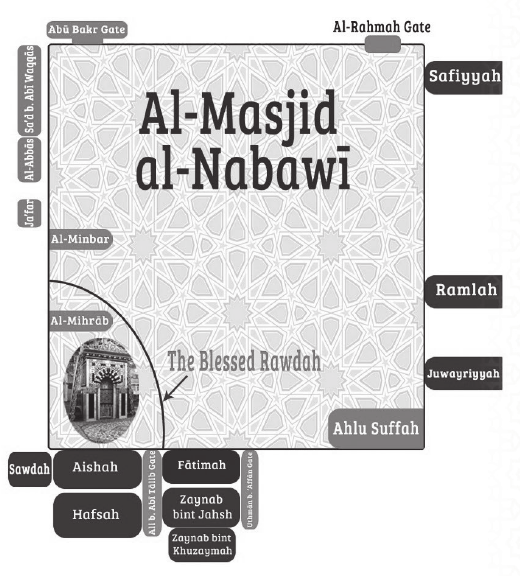
Notice how the majority of the Prophet’s apartments are clustered next to the purified Rawdah (garden), which is a section of Paradise as per the ḥadīth of the Messenger (peace and blessings be upon him):
“Between my house and my pulpit there is a garden of the gardens of Paradise.”109
Historical accounts mention that members of Banī Tamīm had positioned themselves near the Prophet’s apartments. In a raised voice they demanded, “Muḥammad! Bring out three of your men [to duel us] for we are worthy of being praised, and our offence is a disgrace.”110 This type of provocation to a verbal duel was commonplace in Arabia at the time. The duel would involve the two parties mentioning each other’s traits and achievements before determining the better of the two. They continued, “We came to outdo you in status.”
Some narrations specify that the individual who called out was al-Aqraʿ b. Ḥābis who may have been their leader or representative. Since it is customary to attribute the actions of a leader to those who follow, the verse uses the plural construct, ‘yunādūnak’ (those who call out to you). This is similar to attributing a crime to a group saying ‘they’ did it, even when only one person physically executes the crime. It is also possible that they all participated in calling out the noble Messenger (peace and blessings be upon him) in one way or another.
According to other exegetes, the second verse was revealed concerning the two great Shaykhs, Abu Bakr and ʿUmar (raḍiy Allāhu ʿanhumā).111 Contextually, this would have likely been after the event had elapsed and Banī Tamīm had embraced Islām. Now, needing to elect a leader over their locality, the two Sheikhs counselled the Messenger (peace and blessings be upon him) as to who should be appointed. Ibn Abī Mulaikah said:
“The two select, righteous men were about to be ruined, Abu Bakr and ʿUmar (raḍiy Allāhu ‘anhumā).”112
He continued:
“They raised their voice in the presence of the Prophet (peace and blessings be upon him) when the delegate of Banī Tamīm came to the Prophet (peace and blessings be upon him). One of them recommended that al-Aqraʿ b. Ḥābis al-Tamīmī al-Handhalī be appointed as their chief, while the other recommended another. Abu Bakr said to ʿUmar, ‘You only intended to oppose me.’ ʿUmar said, ‘I did not intend to oppose you!’ Gradually, their voices grew louder in front of the Prophet whereupon it was revealed, ‘You who have Īmān! Do not raise your voices above the voice of the Prophet (peace and blessings be upon him).’”
Ibn al-Zubair said, “From then on, when ʿUmar talked to the Prophet, he would talk [so quietly] that the Prophet (peace and blessings be upon him) would ask him to repeat what he said.” In another ḥadīth, Abu Bakr (raḍiy Allāhu ʿanhu) said:
“When the verse ‘You who have Īmān! Do not raise your voices above the voice of the Prophet’ was revealed, I said ‘Messenger of Allāh, by Allāh I will not speak to you except as one telling a secret to another.’”113
Allāh then revealed the third verse (‘those who lower their voices’) as an interjectory statement. It addresses the natural curiosity of those who hear the admonition will have regarding the opposite group – those who lower their voices in the presence of the Messenger of Allāh. It also comes to promptly allay the fears of those who may have thought they were intended in the first address.114
Qur’anic exegetes agree that this distinct reward and praise is primarily directed at Abu Bakr and ʿUmar (raḍiy Allāhu ʿanhuma) because they both never spoke to the Messenger of Allāh (peace and blessings be upon him) after that except by whispering,115 rushing to apply the directive. By extension, this directive applies to each and every individual who lowers their voice in the Prophet’s revered physical presence or figuratively under his Sunnah.
The Companions Ready for Any Occasion
When Banī Tamīm sought to have a duel both in sermon (Khitābah) and poetry (Shiʿr), the companions of the Messenger of Allāh (peace and blessings be upon him) were well-prepared and ready to meet like for like. Collectively, they mastered every art and skill necessary for the function of society, and they directed each of these to the service of Allāh and His Messenger (peace and blessings be upon him), ready for any challenge. Al-Aqraʿ stepped forth with a challenge to the Messenger (peace and blessings be upon him) of poetic expression:
“We came to you and people are well aware of our nobility, particularly if we are opposed when nobility is mentioned. We are leaders, and in all of Ḥijāz there are none like Dārim.116 And to us belong the spoils in every assault in the land of Najd or Tihāmah.”117
The Prophet (peace and blessings be upon him) was eager to address their contest with what is better. He said, turning to his formidable poet Ḥassān b. Thābit (raḍiy Allāhu ʿanhu), “Stand up and reply to him.” Ḥassān stood and determinedly recited:
“Banī Dārim, do not boast, for it is a curse when [true] nobilities are mentioned. You have boasted despite being our pitied servants. If you have come seeking to protect your blood and wealth from distribution, then embrace Islām and stop bragging about ‘Dārim’ in the presence of the Messenger. Otherwise, by the Lord of the House, our spears and swords will be directed at your feeble heads and bodies.”
Al-Aqraʿ b. Ḥābis stood taken aback and said, “What is this? Our spokesperson spoke, but yours was better than ours. And our poet spoke but your poet was better than ours.” Then he approached the Messenger (peace and blessings be upon him) and declared, “I testify there is no Lord worthy of worship but Allāh, and that you are the Messenger of Allāh.” The Messenger (peace and blessings be upon him) replied, “Nothing you did before this will harm you.”118
Notice how the Prophetic community was neither passive in the face of denigration, nor unprepared. Here, the noble Messenger (peace and blessings be upon him) ensured that he utilised the same, impactful modes and arts of communication known to the Arabs. The underlying message is that if you insist on poetry, we have more sublime poetry and are prepared to fight the battle you choose. In fact, the Prophet used to say to Ḥassan (raḍiy Allāhu ʿanhu):
“Satirise [with poetry] against the Quraish, for it is more grievous to them than the hurt of an arrow.” Ḥassan replied, “You have called for this lion who strikes [the enemies] with his tail.” He then brought out his tongue and began to move it and said, “By Him Who has sent you with Truth, I shall tear them with my tongue as leather is torn.”
ʿĀ’ishah (raḍiy Allāhu ʿanha), the narrator, said, “I heard Allāh’s Messenger (peace and blessings be upon him) saying to Ḥassan:
“Verily Rūḥ al-Qudus [Jibrīl (ʿalayhi al- Salām)] will continue to help you so long as you put up a defence on behalf of Allāh and His Messenger.”119
From then on, Ḥassān (raḍiy Allāhu ʿanhu) worked alongside Abu Bakr (raḍiy Allāhu ʿanhu) who was a master of Arabian genealogy. He would ‘spice up’ his poetry with Abu Bakr’s immersed knowledge of some of the family controversies, infamies, and mortifying nuances that the Prophet’s detractors prayed would stay hidden. He would say:
“Tell Abu Sufyan about me. Because you (Abu Sufyān) are in fact a hollow, gaseous coward. Our swords have left you a slave. As for ʿAbdu al-Dār, its leaders are in fact its bondwomen...
“You satirised against Muḥammad, but I answered on his behalf. And with Allāh, for this will be the reward. Do you satirise against him whilst you are not his equal? [After all], the worst of us are bound to ransom our best.”120
The Prophetic community was equipped to address the particular challenges of the time without shying away from using the medium of the time. Their areas of service varied; some were orators, others poets, warriors, scholars or medics. Others still were tillers, homemakers or wealthy businessmen, and they all operated as one unit and served one cause. Had they not seen their own skills as indispensable, and stepped up to the mark in their unique areas of delivery, the Prophetic community would have been left weak and exposed.
If every individual was identical in skill and area of expertise, they could not have bred a firm, complementary communal structure. Such is a pertinent lesson for us in the modern day. Eradicating exceptionally crucial roles, such as those naturally attuned to the Muslim wife and mother, for instance, exposes the family, which is the core of the community, to all types of problems and corruptions. Though it is great to be ambitious, we need not deform our own skills or forgo our own areas of responsibility simply to replicate others, as we are each valuable pieces in a large, symbiotic communal structure.
Finally, Banu Tamīm’s encounter with the companions demonstrates that the latter did not suffer an inferiority complex. They were active in parading the excellence of their values and ways and firmly countered defamation, not least when it came from valueless individuals. Today, we are in dire need of Ḥassāns to likewise use current day effective media channels to satirise and expose the mortifications, corruptions, and controversies of media moguls, Islāmophobic pawns, and populists, and Allāh is the source of strength.
The Personal Impact of the Qur’ān on the Companions
Prior to Ḥassān’s (raḍiy Allāhu ʿanhu) presentation, the orator (Khatīb) who challenged Banī Tamīm and defended the Messenger (peace and blessings be upon him) and the Muslims was a companion by the name of Thābit b. Qais (raḍiy Allāhu ʿanhu). He was elected Khatīb of the Anṣār because of his sound articulation and loud voice and, as such, would often be the Prophet’s spokesman when receiving delegations. Anas b. Mālik (raḍiy Allāhu ʿanhu) narrates that when the verse of al-Ḥujurāt, ‘Do not raise your voices above the voice of the Prophet’ was revealed, Thābit confined himself to his house and said, “I am from the people of Hell.” Thābit’s absence was felt and the Messenger of Allāh (peace and blessings be upon him) turned to Saʿd b. Muʿādh (or Ibn ʿUbādah)121 asking, “Abu ʿAmr, how is Thābit? Has he fallen sick?” Saʿd replied, “He is my neighbour and I have not heard of him falling sick.”
When Saʿd checked up on Thābit, Thābit said, “This verse [of al-Ḥujurāt] was revealed, and you are well aware that amongst all of you, my voice is louder than that of the Messenger of Allāh, and so I am from the people of Hell.” Saʿd informed the Messenger of Allāh (peace and blessings be upon him) who replied, “No, rather he is one of the people of Paradise.” Anas, the narrator comments:
“We used to see him (Thābit) walking between us whilst knowing that he is going to Paradise.” Then on the day of Yamāmah, during the battle against Musailamah the Liar (al-Kadhdhāb), Thābit emerged wearing his death shroud, rebuking the soldiers who had retreated. He fought relentlessly until he fell as a martyr and the prophecy was fulfilled.122 May Allāh be pleased with Thābit.
If the companion who dedicated his voice in the service of Allāh and His Messenger (peace and blessings be upon him) felt that this verse addressed him, how much more does it address those who talk over ḥadīths, interrupt verses being recited or quoted, or throw evidences at one another in arguments? How does it affect our demeanour and respect we show the scholars of Islām, the ‘inheritors of Prophets’ as our Messenger (peace and blessings be upon him) informed us? The companions not only applied the fullest extent of Allāh’s words, but often went to excesses in their erring on the side of caution if they felt it was remotely possible that a verse admonished them.
Allāh Admonishes the Best
With this we learn that the elite of the ummah are not free from admonition. In fact, in certain Qur’ānic instances, even the Prophet (peace and blessings be upon him) was mildly reproved by Allāh and, being His Messenger, none save Allāh can reprove him. As representatives of the Messenger (peace and blessings be upon him), Islām’s leaders are also in need of admonition if they fall short. Naturally, the type and sternness of the admonition is closely associated with what the admonisher would have otherwise expected of the subject. A leader is held to a much higher standard than a layman. Recall the previous discussion on reasons for revelation. Compare the threat of actions being rendered null directed at the two Sheikhs of the ummah with the softer address directed at Islām’s new entrants. In the latter admonition we read:
As for those who call out to you from outside your private quarters, most of them do not use their intellect.123
How intriguing that Abu Bakr and ʿUmar (raḍiy Allāhu ʿanhumā) received the sterner admonition for debating in the Messenger’s presence when their misconduct pales in comparison to those who shouted threats to outdo the Messenger! But Abu Bakr and ʿUmar (raḍiy Allāhu ʿanhumā) are by no means your ordinary Muslims. As the front-runners of humanity, the style of their reproach corresponds. Importantly, this reproach did not negatively affect their Īmān, but instead, perfected it. The same sternness with Islām’s new entrants, whose Īmān had not taken a firm hold, could have been disconcerting and may have had the opposite effect; hence the almost excusatory statement Allāh delivers them.
Remember these techniques when addressing Muslims who are at different levels of devotion. And Allāh knows best.
References (72)
- Al-Qur’ān 53:3-4
- Al-Qur’ān 49:1-4
- Al-Qur’ān 49:1
- Jāmiʿ al-Bayān fī Ta’wīl al-Qur’ān – Imām al-Ṭabarī
- Jāmiʿ al-Bayān fī Ta’wīl al-Qur’ān – Imām al-Ṭabarī
- Al-Muqqadimah fī Usūl al-Tafsīr – Ibn Taymiyyah
- Tafsīr al-Taḥrīr wa al-Tanwīr – Ibn ʿĀshūr
- Tafsīr al-Taḥrīr wa al-Tanwīr – Ibn ʿĀshūr
- Fatḥ al-Qadīr – al-Shawkāni
- Al-Qur’ān 4:59
- See Fatḥ al-Qadīr – al-Shawkāni
- Al-Qur’ān 4:58
- Ṣaḥīḥ Bukhārī and Muslim on the authority of ʿAbdullāh b. ʿUmar (raḍiy Allāhu ʿanhu)
- Mentioned in al-Bidāyah wa al-Nihāyah with an authentic chain of transmission
- Al-Qur’ān 19:93-95
- Tafsīr al-Qur’ān al-ʿAẓīm – Ibn Kathīr
- Abu Dāwūd on the authority of ‘some men who were com- panions of Muʿādh’ as appears in the ḥadīth’s transmission. There is a vast difference of opinion concerning the authenticity of this ḥadīth, but many scholars have accepted it and it has a number of corroborating reports that support it.
- B., Ekrem, “Hejaz railway: A historic line to Islām’s holiest cities”, Daily Sabah (Turkey, 28th October 2016)
- Al-Qur’ān 49:2
- Jāmi’ al-Bayān fī Ta’wīl al-Qur’ān – Imām al-Ṭabarī
- Al-Qur’ān 24:63
- Tafsīr al-Taḥrīr wa al-Tanwīr – Ibn ʿĀshūr
- Al-Qur’ān 2:217
- Al-Muharrar al-Wajīz – Ibn ʿAṭiyyah
- Tafsīr al-Taḥrīr wa al-Tanwīr – Ibn ʿĀshūr
- Narrated by ʿAbdullāh b. Aḥmad in Zawā’id al-Zuhd
- Al-Qur’ān 2:35
- Al-Qur’ān 11:46
- Al-Qur’ān 11:76
- Al-Qur’ān 20:11
- Tafsīr al-Ḥujurāt – Muḥammad Metwalī al-Shaʿrāwī
- Al-Qur’ān 19:52
- Al-Qur’ān 28:44
- Mentioned to this effect in Ta’amulāt Qur’āniyyah – Ṣāliḥ al-Maghamsi
- Al-Jāmiʿ li Aḥkām al-Qur’ān – Imām Qurṭubī
- Ṣaḥīḥ Muslim on the authority of Abu Hurairah (raḍiy Allāhu ʿanhu)
- Al-Qur’ān 49:3
- Jāmiʿ al-Bayān fī Ta’wīl al-Qur’ān – Imām al-Ṭabarī
- Tafsīr al-Taḥrīr wa al-Tanwīr – Ibn ʿĀshūr
- Al-Qur’ān 49:4
- This verse and the one that follows were revealed concerning a group of people from a tribe of Bedouins called Banī Tamīm who came calling the Messenger from behind his apartments saying, “Muḥammad, come out and meet us”. Further explored in Section 1: Those Who Called Out the Messenger, p. 86
- Jāmiʿ al-Bayān fī Ta’wīl al-Qur’ān – Imām al-Ṭabarī
- Al-Qur’ān 49:2
- Tafsīr al-Taḥrīr wa al-Tanwīr – Ibn ʿĀshūr
- Al-Qur’ān 49:5
- Jāmiʿ al-Bayān fī Ta’wīl al-Qur’ān – Imām al-Ṭabarī
- Tafsīr al-Taḥrīr wa al-Tanwīr – Ibn ʿĀshūr
- Al-Qur’ān 42:52
- Tafsīr al-Ḥujurāt – Muḥammad Metwalī al-Shaʿrāwī
- Tafsīr al-Ḥujurāt – Muḥammad Metwalī al-Shaʿrāwī
- Al-Zuhd wa al-Raqā’iq – Ibn al-Mubārak
- Al-Qur’ān 49:3
- Mentioned in Tafsīr al-Qur’ān al-ʿAẓīm – Ibn Kathīr. There is discontinuity in the chain of transmission as Mujāhid did not meet ʿUmar (rady Allāhu ‘anhu), but the meaning of the narration holds true.
- Ṣaḥīḥ Bukhārī and Muslim on the authority of Abu Hurairah (raḍiy Allāhu ʿanhu)
- See Fatḥ al-Bāri by Ibn Rajab al-Hanbalī – translated to this author’s best effort. The Imām seemingly collects the seven categories under resistance to temptation (such as sexual desires) and resistance to anger (such as being a just ruler despite being able to punish opponents).
- Al-Qur’ān 83:14
- Al-Jāmiʿ li Aḥkām al-Qur’ān – Imām Qurṭubī
- Ṣaḥīḥ Bukhārī and Muslim on the authority of Abu Hurairah (raḍiy Allāhu ʿanhu)
- Tafsīr al-Qur’ān al-ʿAẓīm – Ibn Kathīr and others
- Tafsīr al-Qur’ān al-ʿAẓīm – Ibn Kathīr
- Ṣaḥīḥ Bukhārī on the authority of Ibn Abī Mulaikah
- Al-Hākim on the authority of Abu Hurairah (raḍiy Allāhu ʿanhu)
- Tafsīr al-Taḥrīr wa al-Tanwīr – Ibn ʿĀshūr
- Tafsīr al-Taḥrīr wa al-Tanwīr – Ibn ʿĀshūr
- Dārim – a sub-tribe of Banī Tamīm
- Tihāmah could be a reference to Makkah. See Lisān al-ʿArab
- Rūḥ al-Ma’āny – al-Alusi, who references Ibn Hishām’s Sīrah
- Ṣaḥīh Muslim on the authority of ʿĀ’ishah (raḍiy Allāhu ʿanha)
- This latter verse of poetry is known as the ‘most equitable poetic verse an Arab has ever said’ for its power and perfect revenge for the sake of the Messenger of Allāh (peace and blessings be upon him).
- It was most likely Ibn ʿUbādah (raḍiy Allāhu ʿanhu) as Saʿd b. Mu’ādh (raḍiy Allāhu ʿanhu) was martyred long before this event
- Ṣaḥīḥ Muslim on the authority of Anas b. Mālik (raḍiy Allāhu ʿanhu)
- Al-Qur’ān 49:4