In the relationship between man and woman, man embodies the dominant masculine principle infused with a subtle feminine element, while woman reflects the dominant feminine principle imbued with a subtle masculine element. Neither is a complete whole in isolation; each is a complementary half, and only through their union does the fullness of the human reality manifest.
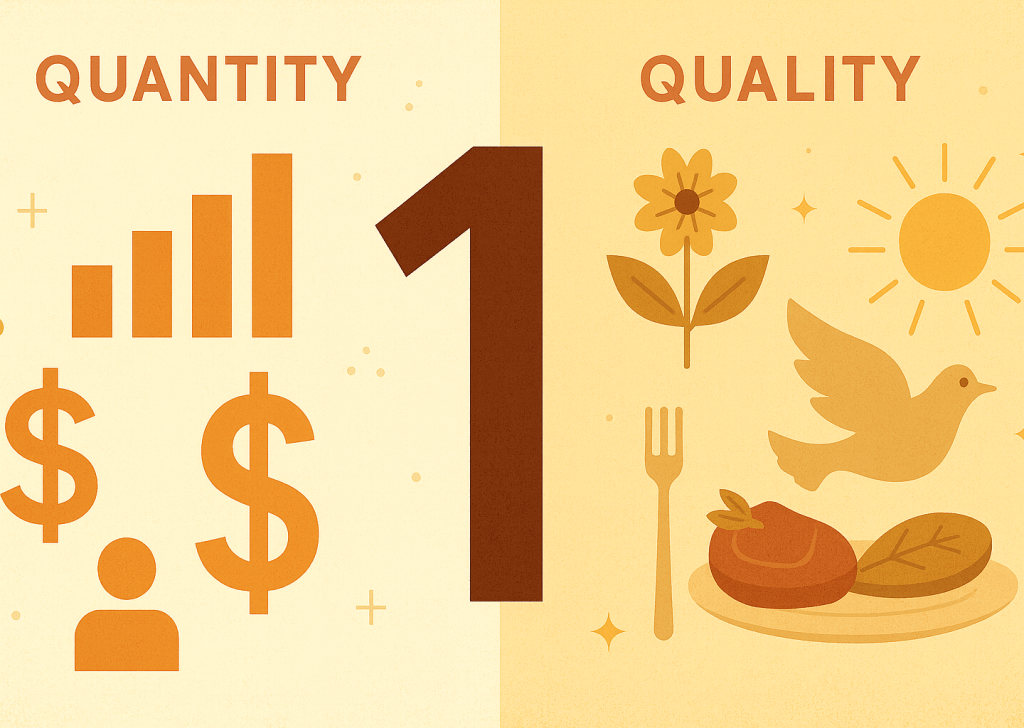
In the modern material world driven by Economics, Capitalism and Consumerism, everything has a cost, everything is measurable, this is the quantitative dimension where even human beings are evaluated by their functionality within the Economic machine, how financial productive they are.
This is in stark contrast to the ancient world where a man’s value is his humility to God as reflected by his honesty, his courage to do what is right and his compassion to his fellow man, all part of the qualitive dimension. In fact, all of creation has a qualitive dimension that cannot be quantified, the sweet scent of flowers, the radiance of the Sun, the music of birdsong, the feel of silk and the taste of fine food to name a few.
From a qualitative dimension, the question of superiority, inferiority and equality is meaningless, and is like comparing the night with the day, the sea with the land, the sweet and the salt and the dry and the wet. Each is different by nature and in these cases are the natural complements of one another.
Within the quantitative dimension, the number one is the smallest integer, the basic building block of larger numbers. The number two is simply two identical versions of one. In fact, all numbers are simply multiples of one. Similarly, all complex entities of creation are seen as just different configurations or arrangements of atoms (or quarks), be it a beautiful gazelle or a lump of coal.
Quality of Numbers and Oneness
It is the qualitative dimension which gives discrimination between the diversity and variations of God’s creation and the ancient world even recognised the qualitative nature of numbers. Pythagoras (600BC) invested specific numbers with mystical properties. According to this, each number has its own quality and is more than simply a multiple of one. The qualitive value is not particular specific to the object, but also related to the perspective of the subject, with the exception of the number one which is universal.
For instance, the number one symbolises unity, completeness, totality and perfection. It is the origin of all things. Furthermore, in contrast to zero which symbolises nothingness, one symbolises existence and reality. Two symbolizes duality and complementarity, gradation, and limitation. Three symbolises creation, shapes, and dimensions. Four symbolises justice and stability, shown in the four seasons and in the four elements of creation; fire, water, earth, and air.
This theme continues throughout the numbers with the number seven symbolising time, cycles and movement, the days of the week, the motions of the planets, the count of the heavens and earth and finds its way in many of the cyclic actions of Islam’s tradition like the circumambulation around the Sacred House, the running between the mounts Safa and Marwah, the number of verses in the greatest chapter of the Qur’an (al Fatiha) and so on.
Even within this modern world, there are many phenomena where no amount of quantification or quantisation can explain and hence we use the expression: ‘The whole is greater than the sum of the parts.’
One Emanates Multiplicity within Unity
One is Perfection and Completeness without deficiency or limitation. The projection of One within the filtered prism of the created realms leads to differentiation and multiplicity. All is created from the One – the Infinite and all of creation echoes His Signature.
God attributes to Himself ninety-nine names and qualities so we may know Him. These qualities are not separate entities, but are qualities of the One God, that project within different domains of creation. God is infinitely beyond all the limitations of human language, imagery or comprehension. Amongst his names, twenty-two form couplets, complimentary qualities which are like two sides of the same coin. These include:
| The Withholder (Al Qaabid) | The Extender (Al Baasit) |
| The Reducer (Al Khaafid) | The Exalter, Elevator (Al Raafi’) |
| The Honourer (Al Mu’iz) | The Dishonourer (Al Muthil) |
| The Originator (Al Mubdi’) | The Restorer (Al Mu’id) |
| The Giver of Life (Al Muhyi) | The Causer of Death (Al Mumit) |
| The Expediter, Promoter (Al Muqaddim) | The Delayer (Al Mu’akhir) |
| The First (Al Awwal) | The Last (Al Aakhir) |
| The Manifest (Al Thaahir) | The Hidden One, Secret (Al Baatin) |
| The Avenger (Al Muntaqim) | The Pardoner (Al ‘Afuw) |
| The Enricher (Al Mughni) | The Withholder (Al Maani’) |
| The Causer of Distress (Al Daar) | The Benefactor (Al Naafi’) |
Furthermore, these names which God attributes to Himself purely for our access and approach to Him, though they ultimately transcend the confines of human language, imagery, and comprehension, can be categorised within other designations such as transient (mutaʿaddī) and intransient (ghayr mutaʿaddī). Transient attributes are those whose effects extend beyond the Divine Self to creation, such as providing, giving life, or forgiving. Intransient attributes, on the other hand, are intrinsic qualities that do not extend outward, such as being Eternal, Living, or Self-Subsisting.
| Intransient (or Passive) | Transient (or Active) |
| The Eternal Lord (Al Malik) | The Beneficent (Al Rahman) |
| All Mighty (Al ‘Aziz) | The Most Sacred (Al Qudus) |
| The Supreme (Al Mutakabir) | The Fashioner (Al Musawir) |
| The All-Knowing (Al ‘Alim) | The Provider (Al Razzaaq) |
| The Impartial Judge (Al Hakam) | The Most Forbearing (Al Halim) |
| The All-Strong (Al Qawiy) | The Most Loving (Al Wadud) |
| The Omnipotent One (Al Qaadir) | The Most Kind (Al Ra’uf) |
| The Powerful (Al Muqtadir) | The Forbearing (Al Sabur) |
The categorisation of qualities into transient and intransient is reflected in the created realm, manifesting in human beings as masculine and feminine attributes. To understand the relationship between man and woman, and thus to accept each’s unique vocation in a modern world that insists on identicality and competition, rather than complementarity and completeness, one must first comprehend two concepts:
Complementary Aspects of One
Perhaps the best visual representation of the concept of complementation is the Chinese symbol of the Ying-Yang. In the tradition, the dark aspect represents the masculine Dragon and the white aspect represents the feminine Phoenix. There are three features of this symbol that are noteworthy:
- The circle symbolises unity.
- The dark and white parts fit perfectly together.
- Each part contains a small element of the complementary aspect.
In the relationship between man and woman, man embodies the dominant masculine principle infused with a subtle feminine element, while woman reflects the dominant feminine principle imbued with a subtle masculine element. Neither is a complete whole in isolation; each is a complementary half, and only through their union does the fullness of the human reality manifest.
Qualities of Man and Woman
Man and woman reflect the different qualities of God, or reflect the qualities of God in differing degrees. Man predominantly reflects the Divine Qualities of Absoluteness and Majesty while woman predominantly reflects the Divine Qualities of Infinity (pertaining to mystery) and Beauty. So, the masculine aspect pertains to strength and objectivity, while the feminine aspect pertains to bounty and gentleness.
The inherent spiritual complementary of man and woman are further reflected at the psychological level in terms of steadfastness and flexibility and physical Level in term of strength and beauty. The spiritual man recognises his need for that complementarity, seeing it as evidencing his inherent incompleteness and his Lord’s perfection. Whereas by forging the lie of man and women equivalence, the modern man deludes himself into the polytheism of self-sufficiency, in competition with his feminine ‘interlocutor’, breeding the incessant forms of feminism (which is in reality a war on femininity) as a reaction. In the Qur’an, God teaches that:
“They (your women) are clothing for you and you are clothing for them.”[1]
The clothing may differ in style and appearance, but provides necessary protection, warmth, covering and fit while accentuating the meanings of responsibility and interdependence between both man and woman at a spiritual, psychological and physical level.
In light of the inherent qualitive differences of man and woman the question of comparison is negated, and the question of equality or inequality becomes peripheral and only limited to material productivity. The only real measure of man and woman is expressed with the Qur’anic verse:
“O mankind! Indeed, We created you from male and female, and made you peoples and tribes so that you may know one another. Verily, the most noble of you in the sight of Allah is the most righteous of you. Indeed, Allah is All-Knowing, All-Aware.”[2]
References:
[1] Qur’an 2:187
[2] Qur’an 49:13

 SarimBlog