Earthly man enclosed in the prison of his five senses needs the excessive character of hyperbolas to make him aware of such realities that can only be truly seen by the supersensory Eye of the Heart awakened by complete piety or death.
The Relativity of Language
The purpose of words is to articulate objects, actions, and emotions; they serve as descriptors. In our upcoming discourse, the traditional world is perceived as a society aware of the One, an All-Knowing, All-Powerful Creator, along with the Day of Reckoning and the Hereafter, in contrast to the pagan, hedonistic tribes of later times.
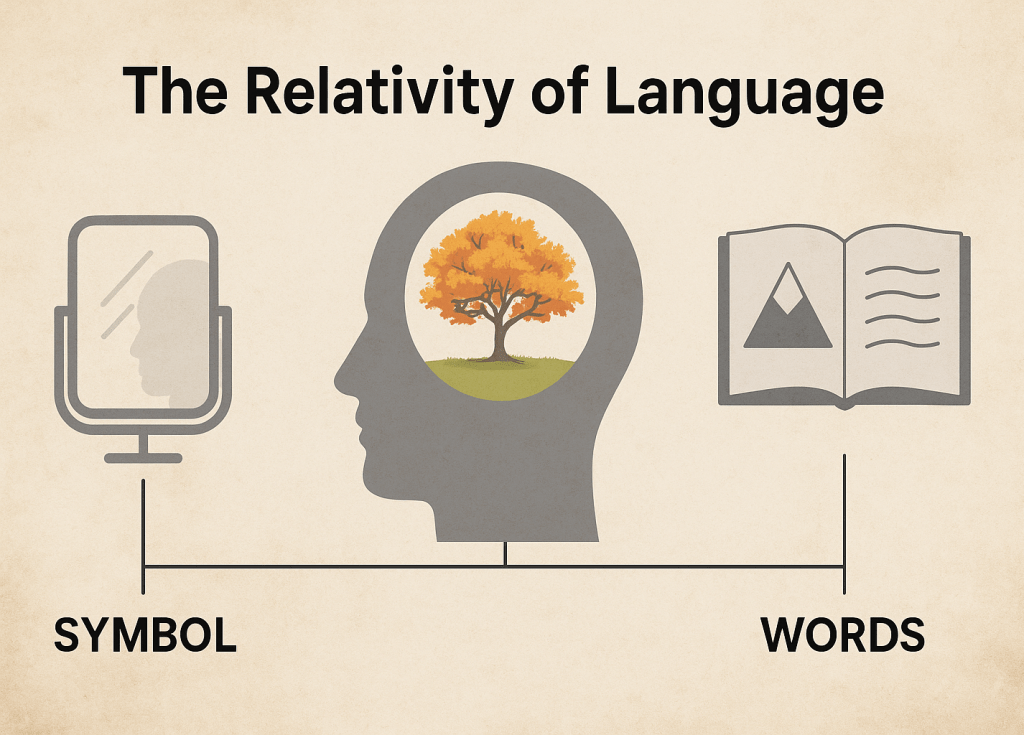
In this traditional framework, a symbol signifies the projection of a greater reality into a lesser one; an image or shadow, while a metaphor captures what lingers from a higher reality. Similarly, words offer projections of a reality without being synonymous with it; they often present a blunt and limited shadow of that reality, and their meanings can vary significantly among different individuals or contexts. Each subject may possess a unique perspective on the Object — highlighting the Object-Subject duality.
In essence, words are symbols, pointers, and signs to realities beyond the actual words themselves. The great intellectual Frithjof Schuon has often addressed the the gap between the expression and the object expressed, the gap between the doctrine and the reality and the gap between the image and the prototype
As a mirror reflects only the surface features of a three-dimensional object, expressions similarly convey only the expressible aspects of that object. In this sense, an expression acts as a two-dimensional image of a three-dimensional reality. A person’s name is merely a superficial label that reveals little to nothing about the depth of their character. For instance, when describing a tree, you can only use adjectives that hold meaning to your senses; the qualities beyond sensory detection remain unknown. Consider the Electromagnetic Spectrum: only the visible portion—light—is accessible to our eyes, while Gamma Rays, X-rays, Ultraviolet, Infrared, Microwaves, and Radio waves, all emitted by physical bodies, elude our sight, highlighting the limitations of both the subject and the words we use.
The Limitation of Words
Imagine describing a landscape to a blind man using only words; even with countless terms at your disposal, can they truly do justice to the scene? Now, envision working with a mere five to ten words—would you be able to convey any distinct qualities of that landscape? In fact, if you attempted to describe the physical universe in just ten to twenty words, you would find there is little distinction or nuance. In the natural world, sights, sounds, scents, tastes, and textures communicate a wealth of information without spoken language: from the light and warmth of the sun to the howling wind, the singing of sparrows, the fragrance of roses, the sweetness of honey, and the softness of silk—these are all signs from God for those who understand.
Sacred art complements nature by serving as a medium for conveying truths that language alone cannot express. In fact, sacred art holds numerous keys and formulas for articulating the linguistically inexpressible, which is why we often say, “a picture paints a thousand words.”
Different Perspectives – The Object-Subject duality
Another essential point is the diversity of expressions. Two writers may describe the same landscape in different and even contradictory ways, yet both perspectives can be equally valid due to the subjective nature of their sights (or sub-objective viewpoints). One writer might portray the desert as massive and awe-inspiring, while another might depict it as deadly and desolate. Similarly, this reflects how different mirror images can represent the same three-dimensional object.
In conclusion, our first two axioms or postulates are:
- The Expression (image) is inherently limited (superficial) or fragmentary.
- The Reality can be articulated through a multitude of expressions (images).
The act of expression has the power to evoke a deeper realisation of the reality it represents. For example, the word ‘tree’ can summon a vivid visual image of a tree in one’s mind, along with the scent of the countryside and the sound of wind rustling through the leaves. This word serves as a gateway to a more profound understanding than what is captured within the word itself, as it engages interactively with the listener.
The Nature of Creation
According to traditional thought in many ancient societies, the world around us consists of three realms of reality:
- The Spiritual Realm (The Supreme and Eternal Reality) [Metacosm]
- The Psyche Realm (The sphere of emotions and reason) [Microcosm]
- The Physical World (The lowest transient, fragmentary and material reality) [Macrocosm]
The entities of the physical world are objects and actions, such as a chair or running. Words here express what can be detected by the five senses. In contrast, the entities of the psychic world consist of emotions and sentiments, such as trust, love, kindness, hope, pride, hate, lust, and envy. In this realm, the limitations of language become apparent, as we often struggle to find the right words to articulate our feelings. Indeed, our thoughts transcend language; even a deaf and blind person can think. However, once we begin to articulate our thoughts, we inevitably bring them into the realm of language.
The Spiritual Realm is the Everlasting Reality that exists in proximity to the Creator of the Heavens and the Earth. Within it lie realities that the eyes have not beheld and words cannot describe. God’s Word, the Qur’an, conveys in the Arabic language the signs and pointers that guide our souls toward a realm beyond the sensory perceptions of this physical existence.
Elliptical and metaphoric expressions frequently convey profound truths and realities that transcend the physical realm. Ancient man, spiritually attuned to these higher realities, may have adopted a literalistic perspective detached from the material world. Literalism is not the same as physicalisation.
Two additional axioms or postulates can be inferred:
- An image or expression has the power to evoke emotions or visions within the soul or mind, facilitating a path toward Greater Realisation.
- When the supersensory faculty (the Eye of the Heart) is pure, the intellect is able to penetrate the image and perceive its Archetype or Essence. In this context, the Intellect serves as the Witness of the Truth, embodying the state of ‘Shahid’, a ‘Witness’. The word ‘Shahīd‘ with a long vowel on the ‘i’ is the term given to the martyr – a person’s who’s eye penetrated the image losing his life for its witnessing the essence of such a sacrifice – God’s pleasure and the Eternal Abode.
Erosion of Language
Traditional society endured for millennia, as it encapsulated certain aspects of Eternity. Consequently, words maintained their original meanings, as understood by Adam (peace be upon him).
Only in today’s world of ever-changing values and trends do we unashamedly distort the true meanings of words, reducing all expressions of Spiritual Reality to mere physical or psychological interpretations. The term Intellect, which signifies the recognition of the Divine, is diminished to mean nothing more than reason. Similarly, the word Beauty is now primarily associated with the feminine body or, even worse, a mere piece of machinery. Modern man is fixated on this physical, temporal, transient reality, and thus strives to redefine language in terms of his concrete surroundings. Many words that traditionally conveyed Metaphysical Realities have been relegated to materialistic definitions. For example:
| Word | Traditional Understanding | Modern Understanding |
| Cosmology | God’s creation of heaven and Earth | Big Bang Theory |
| Justice | One of God’s Attributes (Plato’s Archetype Forms) | Set of laws |
| Heart | Receptacle or ‘Eye of Truth’ | Mechanical pump for blood |
| Man | Viceregent of God | Evolved ape |
| Pen | Conveyance of Truth upon the soul of man | Transfer of ink onto paper |
| Death | Gateway to the Next Life | End of existence |
| Day | Period or duration (associated with the aspect of creation) | 24 hours |
| Supernatural | The eternal realities that transcend the transient world | Human fantasy |
| Metaphor | Meta- (Over/Essence) – phor (result, remains), or in other words, what remains of the essence, like the fragrance when the perfume is removed. | Analogy or example |
| Myth | Conveying supernatural realities within the human experience | Historical legend or fantasy |
Language in Theology
Words and language, shaped by formal (limited) physical realities, are intended to convey the Informal (unlimited) Realities of the Hereafter and the Uncreated Reality of the Creator Himself. Thus, the use of metaphors, hyperbole, and tautology serves to create openings and provide access to realms beyond expression.
God tells us to attribute the highest similitude to describe Him and still nothing is commensurate to Him:
“…to Allah applies the highest similitude: for He is the Exalted in Power, full of Wisdom.”1
“…there is nothing whatever like unto Him…”2
The first verse describes the allowable expression, whereas the second verse describes the Reality.
The expression ‘Praise be to Allah’ can conjure up humility and gratefulness to God, the Omniscient and Omnipotent Source of all Good. It unlocks every sinew of our being to the Mercy of God. The expression is the key that opens the door to God’s Mercy without containing Him.
Indeed, the Names or Attributes of God are projections of the One Indivisible God, representing Archetypal Realities that extend into both the Psyche and Physical realms. These attributes, while expressed through language, cannot be fully defined or confined by it alone. Examples include Beauty, Majesty, Justice, Mercy, and Truth, among others. These ‘Archetypes’ are reflected in the lesser reality, yet they transcend and exist independently of it.
By way of example, Beauty is an archetypal quality, with its reflections in the physical world encompassing a flower, a gazelle, a woman, and more; while its representations in the psyche include generosity and kindness. Similarly, Majesty is an archetypal quality whose reflections in this world include the sun, a lion, a man, and many others; its psychological counterparts are Dignity and Courage. Most objects participate in and reflect multiple Archetypes.
Now whereas Archetypes are Eternal and Incorruptible, images are transient and temporal and are prone to age, decay, and corruption.
Creation Myths
In modern times, myths are understood as historical fantasies, like science fiction today. The ancients were not obsessed with physical precision, but the meaning and purpose and many Cosmological Myths were traditionally methods of conveying metaphysical realities within the human experience without the need to be physically precise.
Prefiguration before Time
Imagine you are writing a story, a theme, a piece of music, there is a moral, idea, vision or emotion you wish to express. The concept or reason or purpose of this creation proceeds its realisation. So, the conceptualisation of a story proceeds the first line written, the first sentence, the first word – it proceeds the beginning of the story.
Similarly, Traditional Cosmology is about the Purpose of Creation that pre-figures even the creation of time itself. Time itself is a facet of Creation in which the narrative of the Theme (purpose) is played out. Hence, ancient descriptions of Creation were not about chronology, time, dates or locations, but purpose and meaning. Cosmology was never the physical iteration in time of matter and energy but expressed the Supernatural purpose and manifestation of Creation including time. Due to its Supernatural origin, the utilisation of precisely formalised, physical defined words in its description would always be limited.
Most present-day sacred text follow a chronological, time-based narrative. The fact that the Qur’an is neither chronological nor follows the rules of horizontal causality is deeply symbolic of its Eternal Nature – the Word of God.
Linguistics in Relation to Eschatology and the Hereafter
“But give glad tidings to those who believe and work righteousness, that their portion is Gardens, beneath which rivers flow. Every time they are fed with fruits therefrom, they say: ‘Why, this is what we were fed with before,’ for they are given things in similitude; and they have therein companions pure (and holy); and they abide therein (forever).”3
The vast majority of words relate to the physical and psychological domains. However, the Spiritual Domain, encompassing Paradise and Hell, is more real than the other two yet transcends human imagination, ultimately eluding precise linguistic description. Once again, God offers similitudes for deeper understanding: Heaven features tranquil, lush gardens with flowing streams, while Hell is characterized by blazing fires fueled by men and rocks, alongside scalding water to drink and shackles binding the souls. Within this realm, there exist qualities far more beautiful and terrifying than any words can convey. To grasp some semblance of these realities, language resorts to Metaphors, Hyperboles, and Tautologies.
Paradisical or infernal imagery often serves as a symbolic paraphrase for realities that transcend the limitations of physical sensory perception. A symbol embodies the projection of a greater reality into a lesser one, akin to an image or shadow. The non-intoxicating wine of paradise and the ever-youthful Houris are designed to evoke a longing for Paradise in humanity, despite the fact that the indescribable realities of Paradise offer pleasures far beyond what words can convey. Conversely, the boiling water and unyielding fire of hell aim to instill a profound fear and dread of hell, even though the true horrors of hell are infinitely more painful than can be imagined.
“And no soul knows what has been hidden for them of comfort for eyes as reward for what they used to do.”4
And in the Hadith that invokes the above verse, the Prophet ﷺ says:
“Allah said: I have prepared for My righteous servants what no eye has seen, what no ear has heard, and what no human heart has conceived. Recite the verse if you wish: No soul knows what has been hidden for them of comfort.”5
A notable observation must be made regarding the Qur’anic statement that Paradise will fulfill ‘all your soul desires’. The pressing question arises: ‘Will evil desires be fulfilled?’. The answer is straightforward: those who enter Paradise will not possess such desires.
Earthly man enclosed in the prison of his five senses needs the excessive character of hyperbolas to make him aware of such realities that can only be truly seen by the supersensory Eye of the Heart awakened by complete piety or death.
References:

 SarimBlog