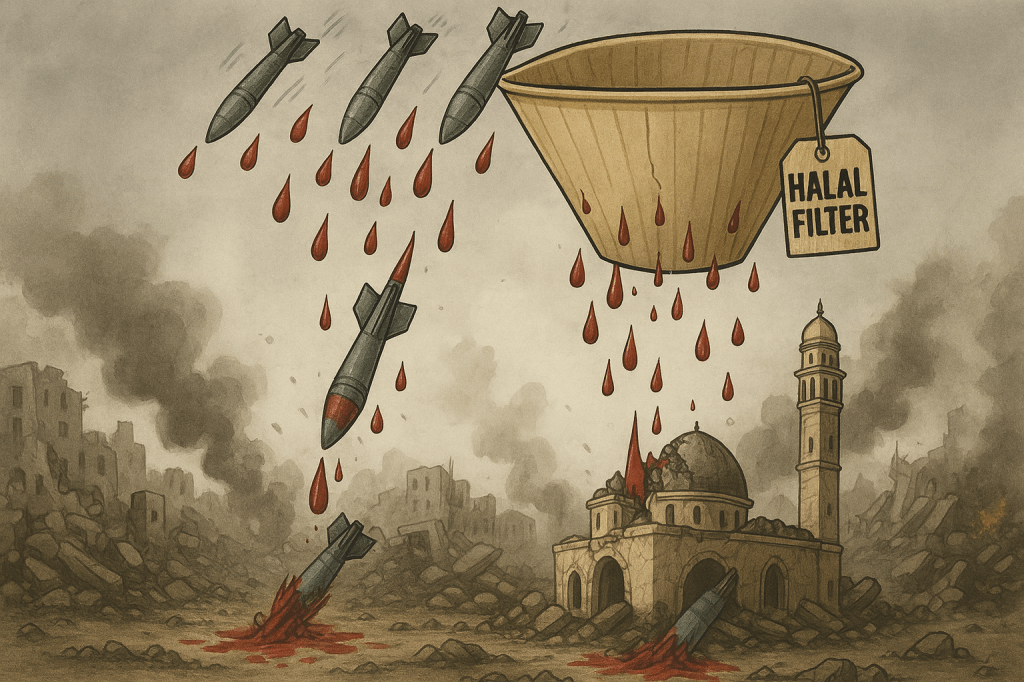
In this Q&A-style piece, we dismantle the key arguments against our exposition of over $2 billion of ‘Shariah-Compliant‘ investment funds poured into Big Tech companies supporting the genocide in Gaza.
- Does Investing in a Company Make You Complicit in Its Actions?
- Are Big Tech Companies Just Neutral Tools, or Active Partners in Genocide?
- Does it Make Sense for Shariah-Compliant Funds to Ignore ‘Ethical’ and ‘Political’ Issues?
- Are Boycotts Pointless Unless They Are Done Collectively?
- Does Buying Shares Actually Fund the Company?
- Is Investing in a Company the Same as Using Its Products?
SarimBlog recently published an article exposing how over $2 billion of ostensibly Shariah-Compliant investment funds are poured into Big Tech companies that are supporting the genocide in Gaza.1 This rather obvious revelation caused quite an uproar.
IslamicFinanceGuru (IFG), a popular Muslim finance platform, responded with an article that acknowledged the problem on the one hand, but ultimately excused Muslim investors.2
The article downplayed the reality that investing in a company amounts to complicity, doubted the effectiveness of divestment, and conveniently relegated genocide-linked investments to the realm of ‘ethical’ and ‘political’ concerns and personal appetites rather than Shariah imperatives.
It also softened the clearly documented role of tech giants like Microsoft and Amazon in the genocide, portraying them as neutral service providers rather than active collaborators.
In this Q&A-style piece, we address the key arguments from the IFG response one by one.
Does Investing in a Company Make You Complicit in Its Actions?
Q: Does an investment imply complicity in what a company does?
A: Of course. If you voluntarily fund or part-own a business that is embroiled in injustice, you are complicit, if not part of the machinery of oppression itself.
The fact a fund is labelled ‘Shariah Compliant’ by a dubious board that 99% of investors cannot even name does not exempt or excuse you.
“Abū Bakr al-Marrūdhī said: When Aḥmad ibn Ḥanbal was imprisoned, the prison guard came to him and asked, ‘O Abā ‘Abd Allāh, is the ḥadīth that has been narrated about the oppressors and their helpers authentic?’ He said, ‘Yes.’ The guard then asked, ‘Am I one of the helpers of the oppressors?’ Aḥmad replied, ‘The helpers of the oppressors are those who cut your hair, wash your clothes, cook your food, and buy and sell from you. As for you — you are one of them.’”3
A new UN report by Special Rapporteur, Francesca Albanese titled, “From Economy of Occupation to Economy of Genocide” listed the said companies as not merely implicated in occupation, but “embedded in an economy of genocide.”
The report went much further than us. While we named five genocide-complicit tech companies that Shariah screened funds have allocated at least $2B to, the UN report named nearly 50 corporate actors doing the same – some also present in Shariah screened funds.4
The report not only implicates the tech giants themselves but abundantly criticises their funders as part and facilitators of the ‘Economy of Genocide’. So what exactly excuses these Shariah stamped funds?
“Help one another in goodness and piety, and do not help one another in sin and aggression.”
There is no conceivable need (Darurah) to hold huge investments in any company whatsoever. Excusing ‘Shariah’ screened investments from complicity, while admitting that they fundamentally do not screen for ‘political’ criteria, which probably includes genocide (disastrously relegated to a political issue) is ludicrous.
The call is not about feeling ‘morally superior’ to anyone else, as the IFG article strangely argues, but to remove you, the investor, from backing apparatus that is unequivocal complicit in genocide. It is that simple.
Are Big Tech Companies Just Neutral Tools, or Active Partners in Genocide?
Q: Maybe Israel just ‘happens’ to use Microsoft, Amazon, etc. Are we overreacting by implying these tech firms are complicit? (IFG gave an example: if an army unit uses Zoom to chat, is Zoom guilty?)
A: The Zoom analogy is honestly ridiculous. Companies like Microsoft, Google, Amazon are not mere spectators whose products get incidentally used by the IDF, as implied in the IFG’s ‘Zoom’ example. They are active collaborators providing intentional, specific and tailored support to the IDF in this genocide.
Ironically, the IFG’s article concedes that Google and Amazon built the $1.2 billion ‘Project Nimbus’ cloud specifically for Israeli military. This is no accidental Zoom call. Meta (Facebook) has systematically censored specifically pro-Palestinian voices, intentionally forging an environment that allows genocide to continue unabated.
In the same aforementioned report, the UN Special Rapporteur lists Microsoft, Alphabet (Google), Amazon, and IBM as “central to Israel’s surveillance apparatus and the ongoing Gaza destruction”.5
Does it Make Sense for Shariah-Compliant Funds to Ignore ‘Ethical’ and ‘Political’ Issues?
Q: Islamic funds say they do not screen for human rights or politics – only for certain haram industries (alcohol, gambling, etc.) and financial ratios. Does that make any sense?
A: For a ‘Shariah‘ branded fund to claim politics is “not in our criteria” is an excuse worse than a sin, especially concerning how these funds market themselves – as ‘pure’ and ‘ethical’. A Shariah filter cannot be limited to a pathetic checkbox exercise, restricted to avoiding pork and baseless percentages of usury. Islam is about upholding justice and goodness in all affairs.
If a fund’s methodology allows investing in a company actively abetting the murder of Muslims, it is fiercely Shariah non-compliant, or simply Haram. The Quranic mandate to prohibit cooperation in injustice does not come with a footnote saying “unless your index provider says it’s okay.”
The current practice of ignoring ‘ethical’ and ‘political’ criteria is a distortion and betrayal of the Shariah, effectively secularising Islam and divorcing it from the real world. Unlike the IFG’s assertions, this is about purity of wealth, as only with pure wealth can our supplications (including for Gaza) be accepted. The Prophet ﷺ taught:
“O people, Allāh is Pure (ṭayyib), and He accepts only that which is pure. Allāh has commanded the believers as He commanded the Messengers: ‘O Messengers, eat of the pure (ṭayyibāt) things and do righteous deeds’ (23:51); and: ‘O you who believe, eat of the pure (ṭayyibāt) things that We have provided you’ (2:172). Then he mentioned a man who has travelled a long journey, dishevelled and covered with dust, who raises his hands to the sky saying, ‘O Lord, O Lord!’—while his food is unlawful, his drink is unlawful, his clothing is unlawful, and he is nourished with unlawful things—so how can his supplication be answered?”6
Are Boycotts Pointless Unless They Are Done Collectively?
Q: The IFG response suggests that effective boycotts require large, coordinated campaigns – implying that individual investors divesting on principle might be futile or just moral posturing. Should we bother avoiding such stocks on our own?
A: This IFG argument unwittingly renders boycotts altogether as futile and meaningless. It is true that a boycott’s full power comes from collective action, but that never absolves individual action as the Prophet ﷺ commanded:
“Whoever of you sees an evil, let him change it with his hand; if he cannot, then with his tongue; if not, then with his heart – and that is the weakest of faith.”
Nowhere does it say “wait until everyone else joins you.”
The global BDS (Boycott, Divestment, Sanctions) movement itself is built on many individuals taking individual action that adds up. If everyone shrugged and said “my share is too small to matter,” nothing would ever change.
Consider a simple analogy: picking up litter in your neighbourhood will not single-handedly solve world pollution, but it is still a good deed, “an act of charity” according to a Hadith. Should we all stop cleaning up trash because there is a “collective action problem” in waste management? Of course not.
If your personal divestment from, say, Amazon or NVIDIA fails to bankrupt those giants, it purifies your own income and contributes, however modestly, to fighting injustice.
The goal of a boycott is “to create real pressure… when a large number of people take focused action in a coordinated way,” as IFG rightly notes. That coordination starts with each person refusing to be complicit. Maybe the IFG, in its position, should lead that duty, rather than finding excuses to run away.
Does Buying Shares Actually Fund the Company?
Q: IFG argues that buying shares on the stock market does not give money to the company – but is just trading between investors. So, is holding shares of these firms really funding them?
A: It is true that when you buy a stock on a secondary market, your money goes to the previous owner of the share, not directly into the company’s bank account. However, it is naïve to conclude that owning shares has no direct effect on the company’s bottom line.
First, every share had to be issued at some point (e.g. an IPO or secondary offering), at which time the company did receive money with practically no overhead. Without willing buyers, they could never have raised funds.
Second, as IFG itself acknowledges, shareholder demand influences the stock price, and a higher share price benefits the company in multiple ways. A strong market valuation gives the company leverage and prestige; it can raise new capital cheaper, use stock as collateral or for acquisitions, and it boosts executive compensation (many CEOs are paid in stock and stock options).
If investors refuse to hold a particular stock, it puts downward pressure on its price and sends a message. And companies do notice when large funds divest on ethical grounds – it signals reputational risk and can influence their behaviour over time.
Global divestment campaigns contributed to ending apartheid in South Africa, by making it harder for complicit companies to do business as usual. The first complete ban of products by a western government, Ireland, began when a one brave cashier, Mary Manning refused to handle the sale of a grapefruit from the apartheid entity.
In our case, the combined Islamic investment in Microsoft is about $600–700 million. The IFG argues this is a mere 0.03% of its value (so does not matter). But what could $700 million do for famine-riven Gaza, in community endowments for Gaza or even for Muslim start-ups? And how does the cost of a cup of coffee compare to Starbucks’ market valuation or a Happy Meal to McDonalds’? Should we end the boycott altogether?
Yes, one person ditching their shares will not topple a tech titan complicit in destroying Palestine, but if we never start, we will never make movement at all. And ultimately, Allah will not ask us about outcomes – those are in His hands – but He will ask about our efforts and intentions. Whatever financial impact our duties yields, big or small, is a just bonus.
Is Investing in a Company the Same as Using Its Products?
Q: A point was made that it is ironic to criticise these companies on devices and platforms they provide – we all use Microsoft, Google, Amazon in daily life. If we cannot avoid their products, is it not hypocritical or futile to avoid investing in them?
A: There is a world of difference between necessary or routine use of a product and voluntarily financing the product’s maker. Yes, many of us unavoidably use some services from these tech giants – our computers run on Microsoft Windows, our phones use Google’s Android, our work may rely on Amazon’s cloud.
We might still use a Windows laptop for work (because there is no viable alternative for us), but that does not mean we should put our savings into Microsoft stock. Limited use of ubiquitous tech versus profiting from that tech’s role in oppression are separate issues. Buying stock is a conscious choice that seeks profit from that company’s success. The Muslim investor potentially wants a company embroiled in genocide… to succeed – think about that.
We pay taxes that fund governments complicit in genocide, but would you buy war bonds to personally fund the next missile? Not being able to do everything is no excuse to do nothing.
It is reassuring that the IFG agrees screens are flawed, but they must own up to the problem they have helped create. Islamic funds and scholars must stop hiding behind technicalities and take responsibility. As we argued in the original piece, we are in front of a scandal of epic proportions that some ‘Shariah Boards’, duty-bound to be at the forefront of supporting the Palestinian struggle have effectively become rubber stamps for investing in genocide. It is time for a reckoning.
The Muslim public is waking up to this hypocrisy. The message is loud and clear: no amount of profit is worth selling out our faith – pull out your investment and stop making excuses.
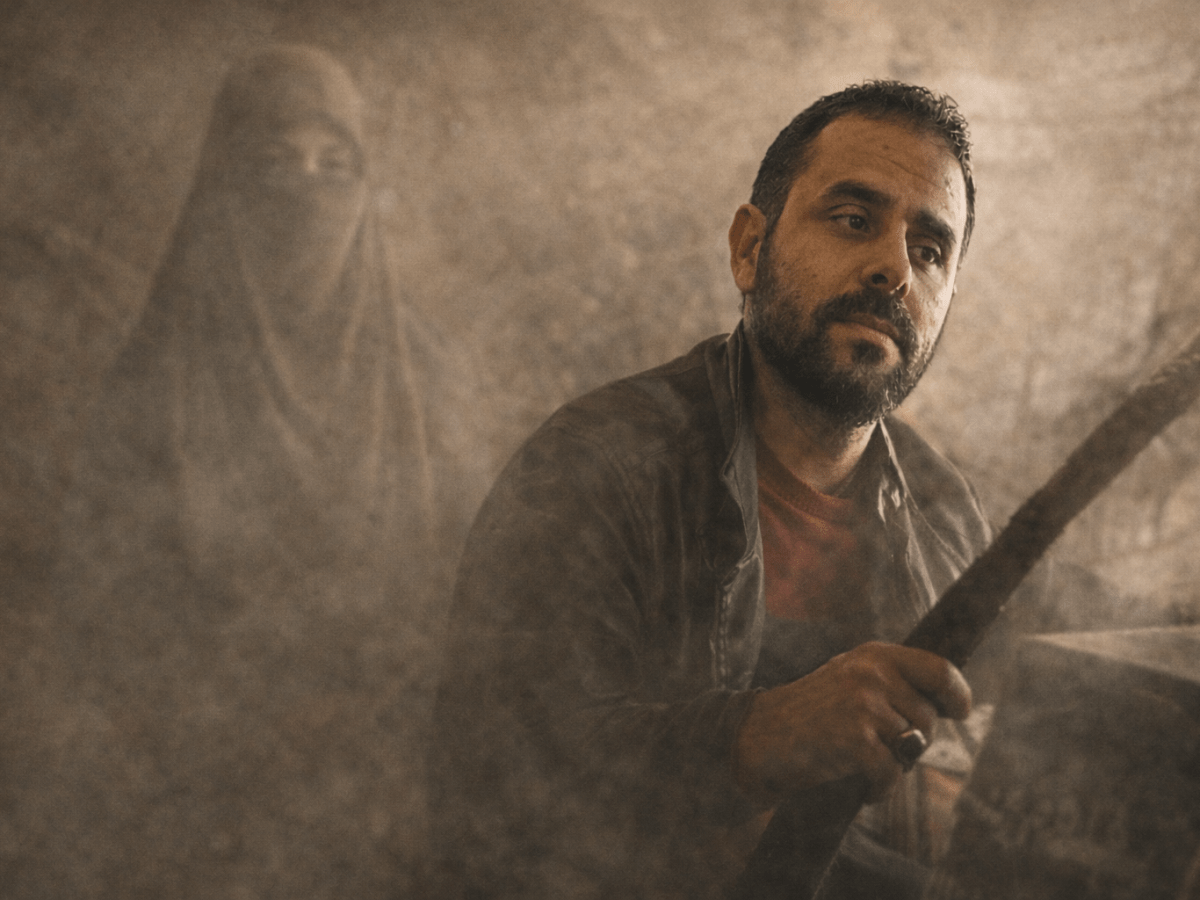
The Woman Behind the Masked Man of Gaza
From the moment Isrāʾ chose Ḥudhayfa, she never left his side. Like the women of the first generation, she carried loyalty as a covenant: with you always, until death…and she kept it.

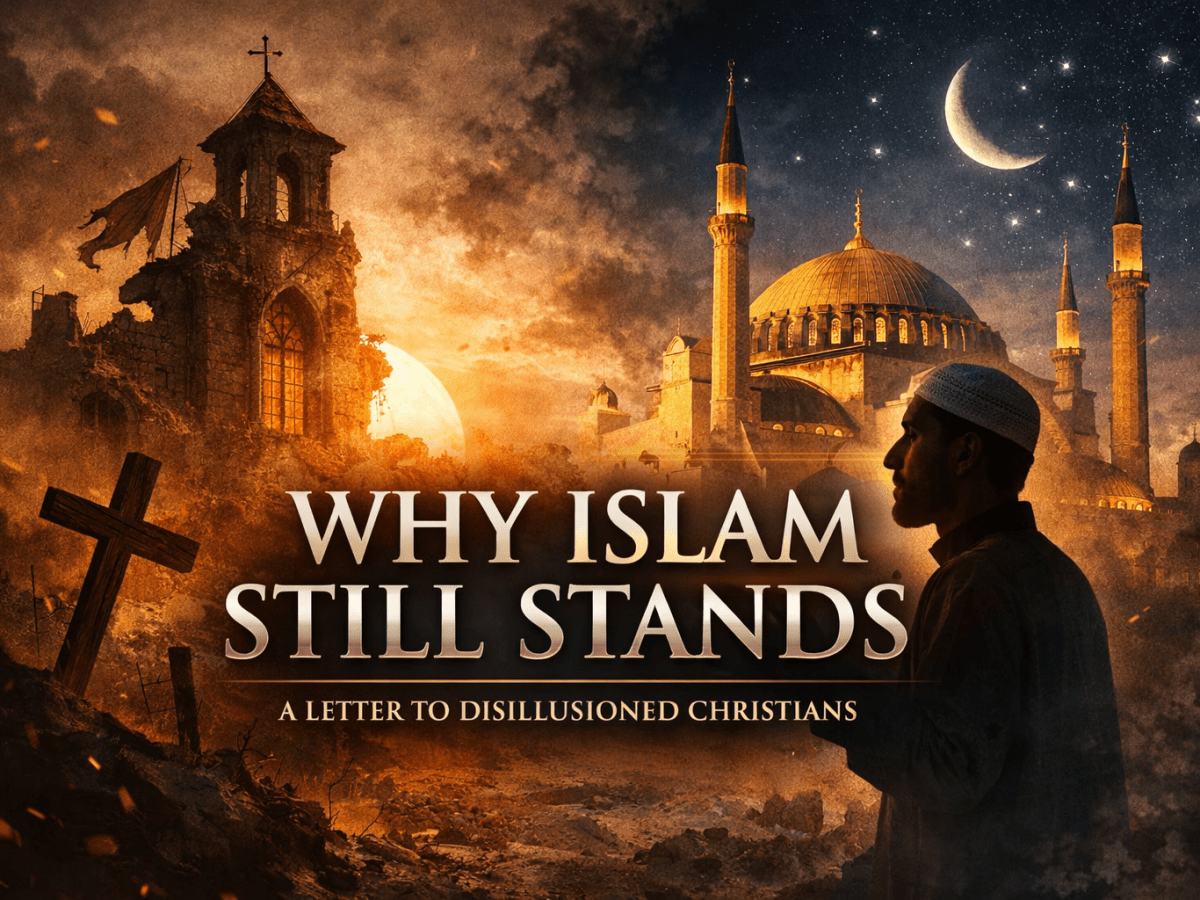
Why Islam Still Stands: A Letter to Disillusioned Christians
The question every Christian should be asking is not why Islam resists reform, but why Christianity required it to survive, and why Islam is now attacked for preserving the very principles the ‘Christian West’ movement claims it wishes to revive.
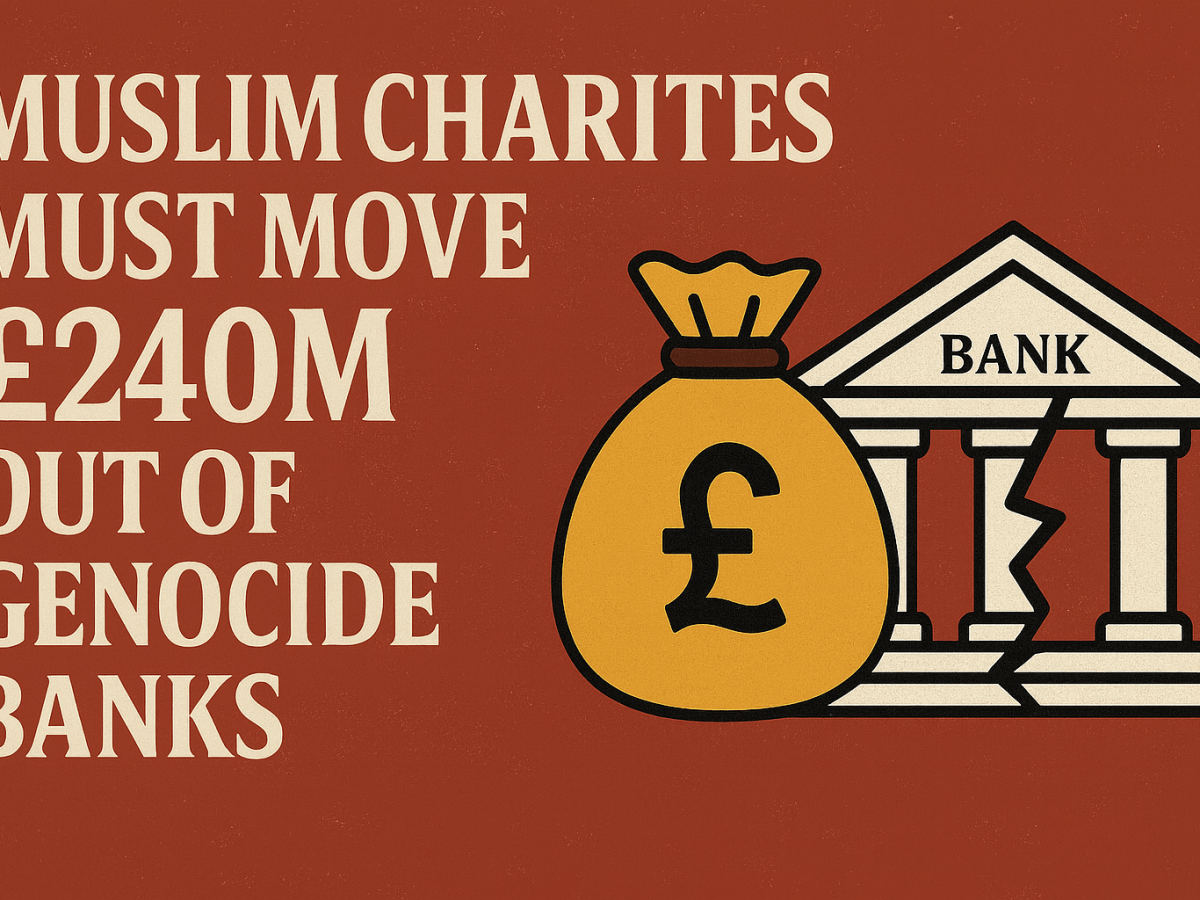
Muslim Charities Must Move £240M Out of Genocide Banks
UK-based Muslim charities collectively retain more than £240 million in accounts with high-street banks directly tied to financing Israel’s military occupation, arms industry, and ongoing genocide…
References:
- Ahmed Hammuda, “‘Halal’ Genocide? The $2B+ Islamic Investment Scandal No One Wants to Face,” SarimBlog, June 9, 2025. ↩︎
- Ibrahim Khan, “Are Islamic Investment Funds Complicit in Genocide?” Islamic Finance Guru, June 17, 2025. ↩︎
- Ismā‘īl ibn Muḥammad al-Asbahānī, Siyar al-Salaf al-Sāliḥīn, p. 1059 (https://islamonline.net/36360) ↩︎
- Federica Marsi, “UN report lists companies complicit in Israel’s ‘genocide’: Who are they?” Al Jazeera, July 1, 2025. ↩︎
- Ibid ↩︎
- Ṣaḥīḥ Muslim, Book of Zakat, Hadith 1015 ↩︎

 SarimBlog
Thank you for this eye opening article. It is understandable to feel hopeless when you also see other Muslims directly investing in Israeli Companies such as Phoenix Insurance directly benefiting from the war
LikeLiked by 1 person
Jazak Allahu Khairan
LikeLiked by 1 person
Says the guy selling his book on Amazon and hosting this page on big tech servers. Irony died wb thousand deaths.
LikeLike
The real scandal. My 7p profit per book (which Amazon doesn’t let me set any lower) and the £40-a-year WordPress hosting fee.
Truly indistinguishable from multi-billion-dollar investments in weapons and surveillance tech fuelling genocide. A devastating exposé. I may never recover.
LikeLike
Ah yes, the heroic 7p martyrdom, while hosting rage bait on Big Tech and selling books through the very system you claim to boycott.
The real scandal isn’t your profit, it’s the moral grandstanding. You profit from the same system you claim to reject, all while guilt-tripping small investors in a financially stretched community. The few platforms you malign are doing more to democratize access than any thread of outrage masquerading as purity.
The difference is, some choose to engage and influence from within rather than divest and disengage. Real change rarely comes from the sidelines.
Conviction isn’t measured by distance from the system, it’s by the impact you make within it.
LikeLike
Clearly the 7p martyrdom scandal is the gravest financial hypocrisy of our time.
But let me entertain you: even if I were a full-time financier of the IDF, say I was Blackrock or Goldman Sachs, the argument in my article would still stand.
What’s curious is that you’ve chosen to obsess over the author rather than engage a single line of the message.
If your definition of ‘influencing from within’ involves investing in companies enabling ethnic cleansing, then perhaps I’m not interested in your argument.
And if you’re truly ‘financially stretched’ yet somehow blessed with so much disposable cash that you can afford to invest in Project Nimbus and the surveillance-industrial complex, that does leave very little for the starving children of Gaza.
But then again, I don’t suppose most IDF investors have ever actually felt hungry.
LikeLike
So £5 of someone’s £1,000 might touch Big Tech, and a fraction of that might unavoidably link to business in Israel, and that makes one an ‘IDF investor’?
Meanwhile, you sell books on Amazon, preach through Google and YouTube, host and post your blog via Microsoft systems.
If proximity equals complicity, you’re not just compromised- you’re a direct contributor to Big Tech’s revenue stream. Not passive. Not incidental. Active.
If not, then maybe ease up on the moral theatrics and fitna. We are all Muslims and contribute in our own way, and investors have more influence than rage baiters.
LikeLike
(It’s actually closer to £500 out of your £1,000, if we’re being honest with the numbers.)
But ultimately, there’s a Hereafter, a Reckoning, and both you and I will stand before the Almighty to answer.
I’ll let you have the last word here. Just consider this sincerely:
Claiming you contributed to ending a genocide by investing in the very AI used to incinerate Gaza because the author of SarimBlog typed an article on a Microsoft laptop may not be the most compelling defence then.
If you’re truly convinced by your position, you can make that argument again, before Allah, the Judge who knows every intention and every penny.
LikeLike
£500 of a £1,000? 50%? Really? I honestly doubt finance/investing is your domain. But that’s okay.
It’s hard to have a sensible conversation with someone who hurls accusations like – you invest in “AI used to incinerate Gaza” – as if it is the absolute objective truth and at the same time dismisses their use of the same suite of tools as a false equivalence.
I wish you well brother. Nobody cares for last words, this is your blog afterall. Of all things, I’m happy I will not appear in front of Allah as a hypocrite, who knowingly or in his ignorance spread fitna that weakens the Ummah.
LikeLike
👍 غفر الله لك
LikeLike