While the world clings to October 7 as an endless pretext for the insanity being meted upon the women and children of Gaza, Israel continues to operate from the same targets of October 7, using the 1948 ethnically cleansed ‘Gaza Envelope’ as its logistical base for genocide.
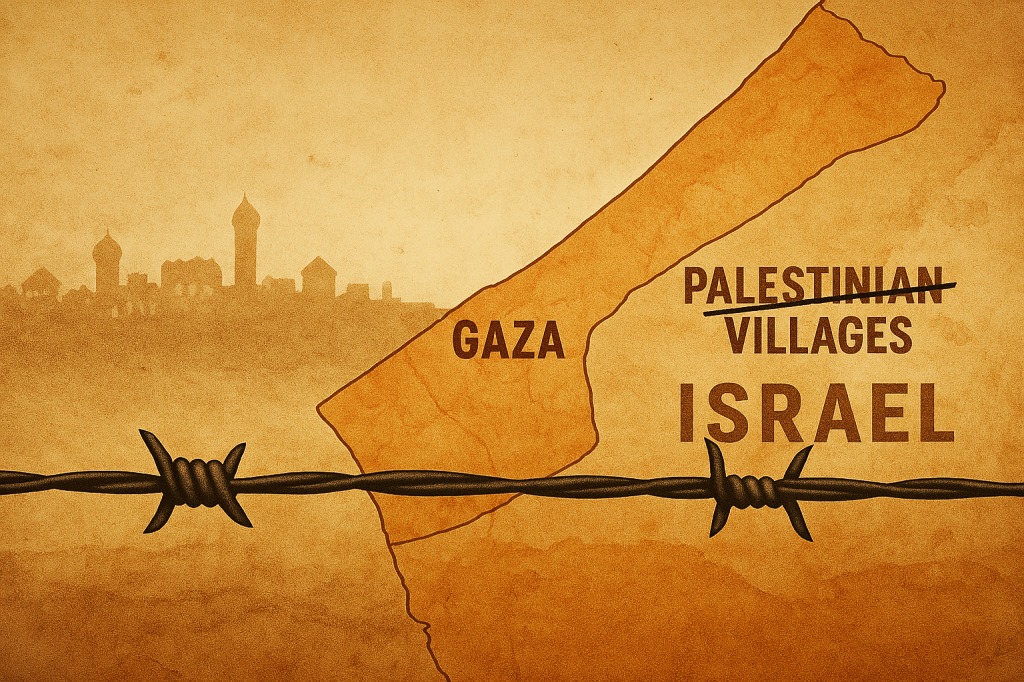
On October 7, 2023, Ezzedeen Al-Qassam Brigades, the armed wing of Hamas and the largest Palestinian resistance group, struck Israeli settlements around Gaza. This cataclysmic, world-changing event, dubbed ‘Al Aqsa Flood’, breached the Gaza military-grade fence in 119 places[1] and targeted nearly two dozen Zionist settlements and military sites, including places like Re’im, Be’eri, Kfar Aza, Kissufim, Nahal Oz, Zikim, Erez, and Kerem Shalom.
The operation would obliterate the Israeli ‘Gaza Division’, responsible for barricading millions of Gazans within a concentration camp for nearly two decades.[2] It would kill many armed and unarmed Zionist settlers, planted in these militarised communities in the crossfire, and send the Israeli occupation into delirium, triggering the Hanibal ‘fire on everything that moves’[3] Directive against its own communities.[4]
Israel then unleashed a campaign of total war on Gaza, resulting in the mass slaughter of civilians, the obliteration of infrastructure, and a scorched-earth policy that targeted women, children, and every vestige of life in the besieged enclave.[5]
Western media rushed to accentuate the impact of the attacks on unarmed Israeli settlers in Gaza’s perimeter. Conspicuously absent from this coverage, however, was the buried history of these sites.
Nearly all of these kibbutzim and military outposts stand on the ruins of Palestinian villages depopulated during the 1948 Nakba – the mass expulsion of Palestinians that marked the brutal birth of the Zionist entity.
Many of the descendants of those villages now live as refugees in Gaza, the very population that subsequently endured the devastating genocide behind the blockade. These once-Palestinian lands, transformed into Israeli kibbutzim and military installations, encircle Gaza and now serve as the current and retroactive facilitators of its contemporary genocide.
| Feature | Historical Gaza Subdistrict (Pre-1948) | Contemporary Gaza Strip |
| Total Area | 2,117 km² | 365 km² (6 x smaller than subdistrict) |
| Population (2023 est.) | 200,000+ (pre-Nakba) | 2.2 million+ |
| Major Towns | Gaza, al-Majdal, Isdud, Beit Tima, Beit Hanun, +40 villages | Gaza City, Khan Yunis, Rafah, Beit Hanun, Jabalia, Deir al-Balah |
| Government | British Mandate of Palestine | Hamas-led administration |
| Status | Most of the area incorporated into Israel post-1948 | Under Israeli-Egyptian blockade since 2007 |
Nakba Villages and the Gaza Perimeter
In the Nakba, some 247 Palestinian localities in southern Palestine alone were emptied, their residents herded into the narrow Gaza enclave. The tiny Strip (just 1.3% of historic Palestine) has become a prison compound for over two million refugees, or 80% of Gazans[6] living within sight of their ancestral homes, in what is now Israel’s southern region.[7]
Villages like Burayr, Huj, Dimra, Hiribya, and Najd, once thriving Gazan communities in the area Gaza were wiped off the map, their lands seized and replaced with militarised ‘farming’ communites.
Many if not all sites attacked stormed on October 7 are built directly atop or adjacent to those 1948 depopulated villages. What Zionists call the ‘Gaza envelope’ – the belt of kibbutzim and military bases around Gaza – is, in large part, historic Gaza itself, or the very land from which Gazans hail.[8]
For example, historians note that Sderot, a town just northeast of Gaza, stands on the lands of Najd, meaning ‘highland’, a Palestinian village whose inhabitants, some 700 were expelled to Gaza by the Negev Brigade in 1948.[9]
To the north, Kibbutz Erez was established on the site of Dimra, part of the Gazan subdistrict where 520 villagers were removed in November 1948.[10] And on the coast, Kibbutz Zikim sits atop Hiribya in the Gaza subdistrict, a historic village dating back to Canaanite times that was emptied in October 1948, forcibly removing its some 2500 residents.[11] The targets of the Palestinian resistance on October 7 were, in living memory, Palestinian communities themselves.
To further illustrate this continuity, consider several of the October 7 attack sites and the villages that preceded them:
- Be’eri (Kibbutz Be’eri) – Founded in 1946 as part of a Jewish National Fund plan to stake claims in the Negev, it was built on lands belonging to the large al-Jabarat Bedouin tribe, who lived in the area. During Israel’s 1948 military campaigns, the indigenous Bedouin owners of this land were expelled – the majority to the West Bank, and others (the smaller al-Hanajura clan) into Gaza.[12]
Nearby stood the Palestinian village of Burayr, home to nearly 2,700 people, which was depopulated in 1948. Here, Jewish militants massacred scores of Palestinian tribesmen and raped and killed a teenage girl.[13] [14] Kibbutz Be’eri thus literally overlays the Nakba’s footprint.
- Kfar Aza – literally meaning ‘Gaza Village’ was established in August 1951, and was part of a post-1948 chain of outpost settlements surrounding the Gaza Strip.[15]
This settlement was built within sight of Gaza City, on lands that had belonged to Gaza’s Turkman Quarter and nearby Bedouin communities.[16] Jewish immigrants from Egypt and Morocco were settled here after undergoing military training helping solidify the appropriation of Gaza City’s outlying orchards and suburbs.
- Nahal Oz – A kibbutz just east of Gaza City, was founded by Zionist militants in 1951 as Israel’s first ‘Nahal’ or military-agricultural colony. Its initial name, tellingly, was Nahlayim Mul Aza, Hebrew for ‘Nahal soldiers facing Gaza.’ It ultimately served to put unarmed Israelis on the front lines as human shields against any Gazan reprisal.[17]
The kibbutz was established on the lands of Bedouin families (Abu Mua’aliq and al-Hasanat) who had lived there before 1948. Those inhabitants were driven out during the war, and by the early 1950s the Israeli army set up this outpost combining farming with military service. Only in 1953 was Nahal Oz formally ‘civilianised.’[18]
Even so, an IDF base was established adjacent to the kibbutz. The area on which Nahal Oz sits had been part of the Gaza district – indeed, part of it was Waqf (Islamic endowment) land of a Gaza shrine (Sheikh Zuwayd/Zarif).[19]
As such, a Nakba depopulated zone became a fortified kibbutz staring down into Gaza.
- Re’im – A kibbutz in the northeast corner of Gaza’s perimeter, Re’im was founded in 1949 by former Palmach (a Jewish terrorist organisation) on lands of the al-Zari’i clan of the Tarabin Bedouin tribe, adjacent to the ruins of an ancient Palestinian town (Tell al-Jamma).[20]
It was initially given a military code-name (Hatzofim Vav, lit. ‘Scouts F’) by its founders. Later it took the name Re’im (‘Hill of Friends’). An Israeli army base has long been maintained near Kibbutz Re’im, and in fact the site served as a staging ground for Israeli troops (for example, as a camp during the 2005 Gaza disengagement).[21] Re’im lies near the former village lands of al-Muharraqa and Juhor al-Dik, whose residents today live in Gaza’s refugee camps.
Not far from Re’im, on the same frontier, is Kissufim, another kibbutz (founded 1951) built on Tarabin clan lands (Abu Khammash).[22]
Also nearby is Kibbutz Nirim, established on the Palestinian ruins of Ma’in (also known as Ma’in Abu Sitta), about 16,000 acres in size, displacing its families to contemporary Gaza.
This included the Abu Sitta family which numbered around 1000 at the time. Among the displaced was the notable Salman Abu Sitta, President of Palestine Land Society in London. The extended family, which is now ten times the size is locked and being bombed in Gaza, while a platoon of less than 500 Zionist settlers occupies Ma’in, now ‘Nirim’.
Close by is Kibbutz Magen which was also built atop the 1948 depopulated village of Ma’in, around a strategic police fort and covering the shrine of a local Palestinian saint (Sh. Nuran).[23]
Prof Illan Pappe notes that here, In August 1949, a 12-year-old Palestinian girl was captured by Israeli militants and held at a base. Over several days, she was gang-raped by Zionist militias, her head shaved and ultimately killed.
Unlike October 7, this was no unsubstantiated allegation, but recorded in David Ben-Gurion’s diary himself only to be later removed by editors. The story resurfaced in 2003 through Haaretz, which published a report based on testimonies from the soldiers involved. Despite the gravity of the incident, the legal consequences were minimal, with the most severe punishment being a two-year sentence for the individual who carried out the killing.[24]
- Zikim – A coastal kibbutz just north of Gaza, Zikim was established in 1949 atop the destroyed Palestinian village of Hiribya. Hiribya’s dates to at least the Canaanite period and it had a population of over 2,000 before 1948 (including 100 Jews and Christians).[25] [26] In the October 1948 Operation Yoav, Zionist forces stormed Hiribya, which lay in the UN-designated Arab zone, and forcibly depopulated it.
Within months, Israel converted the site into Kibbutz Zikim, filling it with settlers to shield the adjoining military base. This dual civilian-military complex was among those struck on October 7, as Qassam Special Forces (‘Nukhba’) landed on Zikim’s beach. While the Hiribyan families of Gaza continue to experience genocide, ‘Zikim’ beach has been rescheduled to reopen for Israeli holiday-makers.[27]
- Kerem Shalom – At Gaza’s southern tip, Kerem Shalom is a kibbutz and major military checkpoint where Gaza, Israel, and Egypt meet. It was founded much later (1967) but likewise sits on lands belonging to local Palestinian communities – specifically the villages of Arab al-Sufiyyin, Abu Uda and Najamat, in and around the district of Beersheba which were depopulated during the 1948 ethnic cleansing.[28] [29]
Today, the Kerem Shalom crossing is one of the choke points of the Zionist blockade. Whatever Gaza-bound trickles of aid (when permitted by the occupation) are routinely ambushed and looted by Zionist settlers[30] who live in and around the Kerem Shalom depopulated villages of the greater Gazan district, infiltrated by Qassam on October 7.
For more than 16 years, Israel has tightly controlled this crossing as part of its siege on Gaza, besieging and containing Gaza’s population in what is a huge repurposing of what was once Palestinian land.
No one will tell you that the October 7 kibbutzim and military sites encircling Gaza are not randomly placed, but deliberately established on the ruins or lands of Palestinian communities erased in 1948.
As an Institute for Palestine Studies report observes, these ostensibly “idyllic farming communities” are in fact “built on stolen land — stolen by Zionists from the Palestinian people through violence.”[31] And the Palestinian families from whom that land was taken, have been “huddled and caged in one small corner of their original lands” (the Gaza Strip) ever since.[32] These crowded refugee camps pressed against barbed wire, where “children are drinking from puddles and wading through sewage pools,”[33] and where people are the subjects of deliberate starvation[34] [35] are within arms’ length of lush fields, swimming pools and orchards now inhabited by Israeli settlers.
From Depopulated Land to Military Settlements
In the immediate aftermath of the 1948 war, Zionist entity went to enormous lengths to ‘guard the frontier’ with Gaza by populating it with loyal Jewish settlers, while cementing these areas with military or paramilitary posts. According to Israeli geographer Prof. Ruth Kark, Zionist authorities rushed to acquire and settle lands in areas allocated to the Arab state by the UN partition, “realiz[ing] the necessity of acquiring as speedily as possible large areas of land,”[36] which included the Gaza region.
In an oral history, Michael Cohen, a member of Israel’s Negev Brigade—formed from the terrorist Palmach, the elite force of the Haganah—openly recounts the deliberate and systematic expulsion of Palestinians in October 1948 from areas surrounding today’s Gaza Strip. He admits that most Palestinians posed no threat, stating plainly, “the majority had no plans to hurt us,” yet they were expelled because “we couldn’t allow ourselves… to leave Arab settlements in our underbelly… The Negev was cleared of all villages!” Cohen explains that Palestinians who tried returning to their homes posed a problem, stating that to “block” returning Palestinians meant “shoot to kill.” He bluntly acknowledges his direct involvement, stating unequivocally, “I didn’t just see it with my own eyes, I also did it.”[37]
Many Gaza-border kibbutzim originated under the Nahal program, which combined farming with military service. Kibbutz Nahal Oz, previously mentioned, is the archetype and first of such military Kibbutzim. Members of this military farming settlement regularly conducted armed raids into Gaza City.[38] In short, and in contrast to the post-October 7 prevailing narrative that has subsequently endorsed a genocide, the Gaza perimeter communities were founded with security and territory in mind, not merely agriculture.
Over time, permanent IDF bases and fortifications sprouted alongside these kibbutzim. By placing civilian settlements adjacent to military infrastructure, the Zionist entity was able to maintain a presence that was partly civilian (families farming, living normal lives) and partly military (outposts, training grounds, surveillance equipment).
For instance, an Israeli army base sits next to Kibbutz Re’im, and Nahal Oz also has a long-maintained military installation. Zikim hosts a key military training base near its civilian area, and is also adjacent to a naval base on the coast. Erez became the site of an industrial zone and military checkpoint tightly controlling Gaza’s northern exit. Kerem Shalom, as mentioned, functions as a militarised checkpoint on Gaza’s south. In effect, a network of militarized kibbutzim forms a strangling buffer around Gaza.
Human Shields?
Pawns of the Zionist state customarily use the ‘Human Shields’ accusation to justify the obliteration of schools, hospitals and UN shelters. While it is not logically possible for a besieged people, living in their own land and under the threat of extermination[39] to resist in some way remote from those being exterminated, Israel populates the ethnically cleansed Gaza border with its own locales.
It built kibbutz dining halls and children’s dormitories next to tank emplacements; it placed farms and factories within mortar range of Gaza, then launched attacks from nearby artillery positions.
Zionist authorities have intentionally created a situation where settlers live cheek-by-jowl with settler-colonial military objectives (bases, surveillance towers, armoured units) along Gaza’s edge, including the contemporary re-occupation of Gaza. Their settlers act as a buffer – or human shields, in effect, for the military. The fact that some of these kibbutzim began as Nahal outposts (military units in farming guise) tells that from inception, they were a fusion of settlements and military strongpoints.
According to the International Committee of the Red Cross, the use of “human shields” is defined by the intentional co-location of military targets and civilians to deter enemy attack,[40] which becomes an inevitability when collocating civilians on illegally appropriated lands.
Did Israel deliberately hope that Palestinian fighters would refrain from attacking these sites because settlers lived there? One might argue that Israel’s settlement policy on Gaza’s frontier turned its own citizens into unwitting sentinels, and ultimately into targets, by design. A practice clearly “endanger[ing] civilians, as it turns civilian objects into military targets” (to quote Amnesty International’s critique in a different context).[41]
The Palestinian resistance acknowledged its attempt to avoid harming civilians as a “religious and moral commitment,” acknowledging that “maybe some faults happened” due to the rapid flight of Zionist militants and the collapse of their brittle military installations.
And while the world clings to October 7 as an endless pretext for the insanity being meted upon the women and children of Gaza, Israel continues to operate from the same targets of October 7, using the 1948 ethnically cleansed ‘Gaza Envelope’ as its logistical base for genocide.
Beyond the Blockade, a Struggle Against Settler-Colonialism
The conventional narrative is that Hamas fighters attacked Israel in retaliation for the suffocating blockade on Gaza. That is true, but it is not the whole story. The attack was also rooted in a 75-year-long struggle by Palestinians to return to lands taken from them in 1948. As Palestinian historian Salman Abu Sitta (himself a refugee from the Gaza perimeter) wrote,
“My cousins never wavered to cross the barbed wire and try to return home, in the same manner of October 7. They crossed the barbed wire and attacked the occupiers of our land… they generally tried to restore life to Ma’in Abu Sitta, our land.”[42]
In the decade after 1948, thousands of Palestinian refugees undertook clandestine attempts to go back to their villages to harvest fields, reclaim property, or simply resettle only to be murdered by Zionist patrols. Those early fedayeen raids of the 1950s were a precursor to what happened on October 7, 2023, when the Qassam Brigades breached the Gaza fence en masse. The difference is only in the scale and coordination of the October 7 operation. However, the motivation is indomitable as it connects to the Nakba, resisting injustice and the right of return as much as to the immediate siege of Gaza.
The injustice is not confined to Gaza’s borders or the post-2007 blockade, but encompasses all of historic Palestine it was the eruption of a long-suppressed fury against settler colonialism and occupation in all of Palestine, from 1948 to the present. Every Zionist should know that the genocide has exacerbated, intensified and internationalised the same struggle for decolonisation and liberation.
References:
[1] The Jerusalem Post. (August 31, 2024). Retrieved [5 April 2025] from: https://www.jpost.com/israel-hamas-war/article-817176
[2] +972 Magazine. (April 1, 2025). Retrieved [5 April 2025] from: https://www.972mag.com/israel-gaza-concentration-camp-expulsion/
[3] The Palestine Chronicle (February 28, 2025). Retrieved [5 April 2025] from: https://www.palestinechronicle.com/anything-that-moved-israel-admits-air-force-applied-hannibal-directive-on-oct-7/
[4] Al Jazeera. (February 28, 2025). What has the report into Israeli military failures on October 7 said? Retrieved [5 April 2025] from: https://www.aljazeera.com/news/2025/2/28/what-has-the-report-into-israeli-military-failures-on-october-7-said
[5] Genocide ongoing to date of article
[6] Mondoweiss. (January 4, 2024). I could have been one of those who broke through the siege on October 7. Retrieved [5 April 2025] from: https://mondoweiss.net/2024/01/i-could-have-been-one-of-those-who-broke-through-the-siege-on-october-7/
[7] Institute for Palestine Studies. (October 25, 2023). Retrieved [5 April 2025] from: https://www.palestine-studies.org/en/node/1654492
[8] Ibid
[9] Ibid
[10] Morris, B. (2004). The Birth of the Palestinian Refugee Problem Revisited. Cambridge University Press.
[11] Khalidi, W. (Ed.). (1992). All That Remains: The Palestinian Villages Occupied and Depopulated by Israel in 1948. Institute for Palestine Studies.
[12] HLRN (Housing and Land Rights Network) – “Hamas ‘Civilian’ Targets on 7 October 2023” (contextual report, 2023)
[13] PalestineRemembered.com. (n.d.). Retrieved [5 April 2025] from: https://www.palestineremembered.com/Articles/Biladuna-Filisteen/Story21925.html
[14] Morris, B. (2004). The Birth of the Palestinian Refugee Problem Revisited. Cambridge University Press.
[15] Piraino, C. (Jan 8, 2024). Ghazza, Aza: What’s the story of the Gaza Envelope? [Medium post]. Retrieved [5 April 2025] from: https://medium.com/@cara.piraino/ghazza-aza-whats-the-story-of-the-gaza-envelope-abd256b6a140
[16] Institute for Palestine Studies. (October 25, 2023). Retrieved [5 April 2025] from: https://www.palestine-studies.org/en/node/1654492
[17] Palestine.beehiiv.com. (June 14, 2024). A brief history: Israel’s use of Israeli human shields. Retrieved [5 April 2025] from: https://palestine.beehiiv.com/p/brief-history-israels-use-israeli-human-shields
[18] HLRN (Housing and Land Rights Network) – “Hamas ‘Civilian’ Targets on 7 October 2023” (contextual report, 2023)
[19] Institute for Palestine Studies. (October 25, 2023). Retrieved [5 April 2025] from: https://www.palestine-studies.org/en/node/1654492
[20] Ibid
[21] HLRN (Housing and Land Rights Network) – “Hamas ‘Civilian’ Targets on 7 October 2023” (contextual report, 2023)
[22] Institute for Palestine Studies. (October 25, 2023). Retrieved [5 April 2025] from: https://www.palestine-studies.org/en/node/1654492
[23] Ibid
[24] Pappé, I. (2006). The Ethnic Cleansing of Palestine. Oneworld Publications.
[25] 1945 Village Statistics Scan. (n.d.). Retrieved [5 April 2025] from: https://users.cecs.anu.edu.au/~bdm/yabber/census/VSpages/VS1945_p31.jpg
[26] Khalidi, W. (Ed.). (1992). All That Remains: The Palestinian Villages Occupied and Depopulated by Israel in 1948. Institute for Palestine Studies.
[27] Jewish News Syndicate (JNS). (March 25, 2025). Zikim beach to reopen for the first time since Oct. 7. Retrieved [5 April 2025] from: https://www.jns.org/zikim-beach-to-reopen-for-the-first-time-since-oct-7/
[28] PalestineRemembered.com. (1998). Palestine English Map 2004. Retrieved [5 April 2025] from: https://www.palestineremembered.com/Maps/New/pal-english-2004.jpg
[29] PalestineRemembered.com. (n.d.). al_Soufi_Najamat (Statistics). Retrieved [5 April 2025] from: https://www.palestineremembered.com/GeoPoints/al_Soufi_Najamat_777/index.html#Statistics
[30] BBC News. (n.d.). Retrieved [5 April 2025] from: https://www.bbc.com/news/articles/cz9950n003yo
[31] Institute for Palestine Studies. (October 25, 2023). Retrieved [5 April 2025] from: https://www.palestine-studies.org/en/node/1654492
[32] Ibid
[33] CNN. (2024, August 23). Israel-Gaza water shortages intensify amid heatwave. Retrieved [5 April 2025] from: https://edition.cnn.com/2024/08/23/middleeast/israel-gaza-water-shortages-heatwave-crisis-intl/index.html
[34] Middle East Monitor. (2024, October 18). The Generals’ Plan in Gaza: A genocide by starvation? Retrieved [5 April 2025] from: https://www.middleeastmonitor.com/20241018-the-generals-plan-in-gaza-a-genocide-by-starvation/
[35] B’Tselem. (2024, December 24). Deliberate Starvation in Gaza. Retrieved [5 April 2025] from: https://www.btselem.org/video/20241224_deliberate_starvation_gaza_december_2024
[36] Piraino, C. (Jan 8, 2024). Ghazza, Aza: What’s the story of the Gaza Envelope? [Medium post]. Retrieved [5 April 2025] from: https://medium.com/@cara.piraino/ghazza-aza-whats-the-story-of-the-gaza-envelope-abd256b6a140
[37] Institute for Palestine Studies. (October 25, 2023). Retrieved [5 April 2025] from: https://www.palestine-studies.org/en/node/1654492
[38] National Library of Israel (NLI) Blog. (February 8, 2024). Nahal: The story of the green brigade. Retrieved [5 April 2025] from: https://blog.nli.org.il/en/nahal-the-story-of-the-green-brigade/
[39] Human Rights Watch (HRW). (2024, December 19). Israel’s Crime of Extermination: Acts of Genocide in Gaza. Retrieved [5 April 2025] from: https://www.hrw.org/news/2024/12/19/israels-crime-extermination-acts-genocide-gaza
[40] International Committee of the Red Cross (ICRC). (n.d.). Customary IHL – Rule 97. Retrieved [5 April 2025] from: https://ihl-databases.icrc.org/en/customary-ihl/v1/rule97
[41] Amnesty International. (2022, August 4). Ukraine: Ukrainian fighting tactics endanger civilians. Retrieved [5 April 2025] from: https://www.amnesty.org/en/latest/news/2022/08/ukraine-ukrainian-fighting-tactics-endanger-civilians/
[42] Mondoweiss. (2024, January). I could have been one of those who broke through the siege on October 7. Retrieved [5 April 2025] from: https://mondoweiss.net/2024/01/i-could-have-been-one-of-those-who-broke-through-the-siege-on-october-7/

 SarimBlog

