When one reflects upon the life of Ibrahīm, one witnesses the essence of submission. He submitted to Allāh by turning away from his pagan people, by leaving his son in the desert, and by obeying the command to sacrifice his son. Therefore, it is only fitting that prophet Ibrahīm is the one who bestowed upon believers the name “the ones who submit” (Muslims)
Article Author: Islam Hasan
The month of Dhul Hijjah is a time of abundant mercy from Allāh, during which He amplifies the rewards to such an extent that the deeds performed in these days are more beloved to Him than any other deeds. In a Hadīth, the Messenger of Allāh, sala Allāhu ‘alayhi wasalam, stated:
“No good deeds can be done at a time better than these first ten days of Dhul-Hijjah.” It was said, “Not even jihād in the way of Allāh?” The Prophet said, “Not even jihad in the way of Allāh.”[1]
Glorified is the Creator, Allāh, who confers the opportunity, each year to gain more reward than that associated with struggling in his cause, al Jihād. It makes one wonder why such reward is associated with these days, besides any other day in the year.
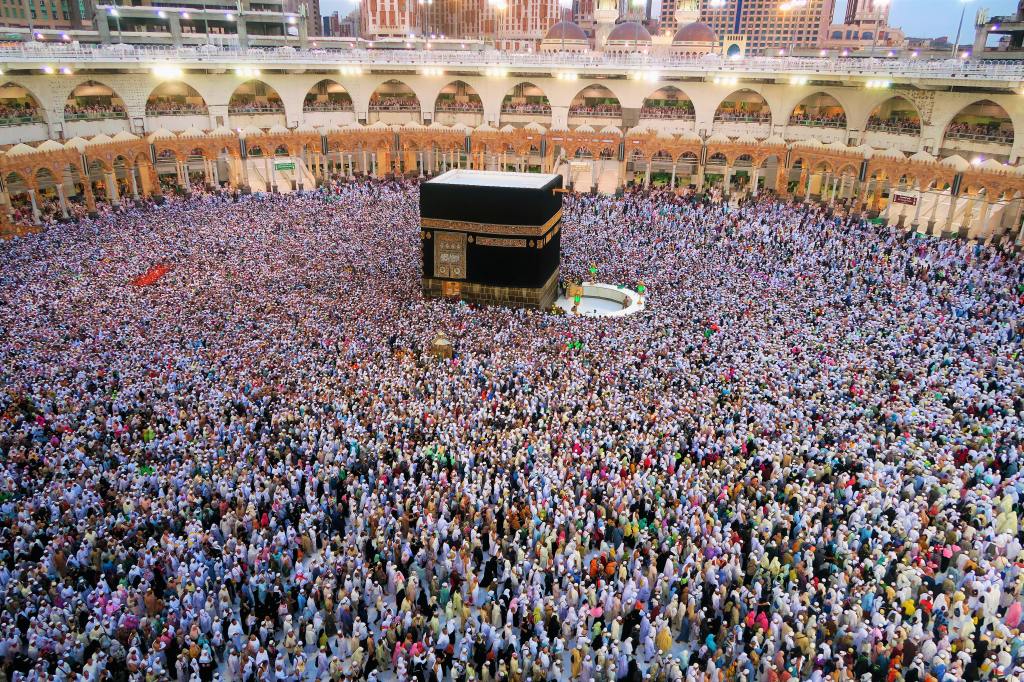
This is the Month of Hajj. The month that exemplifies the way of prophet, and leader of the monotheistic tradition, Ibrahīm ‘alayhi asalām. This month enacts and preserves his everlasting way, granted by the Creator to the final Nation of Truth, the Muslims. Hajj is one of the most powerful and profound obligations upon the able Muslim. But one cannot understand Hajj, or indeed Dhul Hijjah without revisiting the character and life of Prophet Ibrahīm ‘alayhi asalām.
Prophet Ibrahīm was born in Iraq, amidst a pagan society. Notably, his father was a skilled craftsman who meticulously sculpted the idols worshipped by their people. Despite the formidable social pressure and the intricate dynamics between Ibrahīm and his father, who would shun his son for denouncing idolatry, Ibrahīm unwaveringly surrendered himself to the Ultimate Truth. Guided by Divine Wisdom, Ibrahīm recognised that the Omnipotent cannot be encapsulated within a mere artifact, shaped by human hands. The Creator transcends creation itself and remains unbound by the limitations of the physical realm.
“Then when he saw the sun shining, he said, ‘This must be my Lord—it is the greatest!’ But again when it set, he declared, ‘O my people! I totally reject whatever you associate ˹with Allāh in worship.˺ I have turned my face towards the One Who has originated the heavens and the earth—being upright—and I am not one of the polytheists.”[2]
However, Ibrahīm did not keep the Truth to himself; he courageously challenged the ways of his people. He smashed the idols they worshipped, except for the largest one. When confronted by his people about his actions, Ibrahīm mockingly responded, “No, the biggest of them did it! So ask them, if they can talk!“[3] Despite the obvious absurdity of their practices, his people stubbornly clung to their polytheistic beliefs, refusing to acknowledge the truth. In an act of defiance, they resolved to catapult Ibrahīm into a raging fire.
Ibrahīm’s unwavering devotion to Allāh was so profound that he was willing to sacrifice everything for the sake of his Creator. He was prepared to relinquish his wealth, which would have come from his father’s business, his position in society, his family, and even his life. Placing his complete trust in Allāh, Ibrahīm faced the fire with unwavering faith. And in His infinite mercy, Allāh saved Ibrahīm from the flames.
An exiled Ibrahīm went on to spread the message of Truth to the world, supplicating to His Creator:
“My Lord! Bless me with righteous offspring.”[4]
The desire to have children is a natural inclination instilled by Allāh in the hearts of humanity. It is part of our innate nature (Fitrah). However, Ibrahīm’s purpose went beyond mere parenthood; he sought to raise descendants who would be instruments for spreading truth and righteousness throughout the world. In response to his noble aspiration, Allāh granted him the glad tidings of a patient and steadfast son.
Yet, as a test of Ibrahīm’s devotion, Allāh commanded him to leave his beloved wife and the son he had long yearned for in the barren desert. It was a desolate land devoid of any sustenance, a circumstance that could have been perceived as a death sentence by many. Nevertheless, Ibrahīm submitted wholeheartedly to the will of Allāh and obeyed His command.
This act of leaving his family in the desert holds great significance for Muslims performing Hajj. On the Hajj, Muslims re-enact the desperation of Hajar, Ibrahīm’s wife, as she anxiously ran between the hills of Safa and Marwa, searching desperately for water. It was in this dire situation that Allāh caused the miraculous spring of Zamzam to burst forth from beneath the feet of Ibrahīm’s son, Isma’īl. This symbolizes the divine providence and mercy that sustained Hajar and her son in their most testing moments.
Finally, Ibrahīm faced another profound test involving his son. After Isma’īl, a prophet in his own right and Ibrahīm’s beloved son, had reached an age where he could actively contribute, and Ibrahīm had developed a deep bond with him, Allāh tested Ibrahīm with the greatest trial of all: to sacrifice his son.
“When he reached the age of exertion, he said, ‘O my son, indeed I have seen in a dream that I must sacrifice you, so see what you think.’ He said, ‘O my father, do as you are commanded. You will find me, if Allāh wills, among the steadfast.‘”[5]
Once again, Ibrahīm wholeheartedly submitted to the will of Allāh. It is noteworthy that Allāh blessed him with a son who also displayed unwavering submission who would continue Ibrahīm’s prophetic message. When Ibrahīm surrendered to Allāh’s decree, Allāh ransomed Isma’īl with a ram who would be sacrificed in his place. This was a divine test, one not to deprive Ibrahīm of a son, but to trial the extent of his submission to His creator and he truly excelled.
“˹Remember˺ when Abraham was tested by his Lord with ˹certain˺ commandments, which he fulfilled. Allāh said, ‘I will certainly make you into a role model for the people.’ Abraham asked, ‘What about my offspring?’ Allāh replied, ‘My covenant is not extended to the wrongdoers.’”[6]
This significant event in Ibrahīm’s life has become a timeless symbol of devotion to the Creator and a profound inspiration for Muslims worldwide. It is commemorated annually by Muslims on the 10th day of Dhul Hijjah through the act of offering a sacrificial animal. This act represents an intense expression of devotion to Allāh, uniting Muslims across the globe in their reverence for their Creator.
When one reflects upon the life of Ibrahīm, one witnesses the essence of submission. He submitted to Allāh by turning away from his pagan people, by leaving his son in the desert, and by obeying the command to sacrifice his son. Therefore, it is only fitting that Prophet Ibrahīm is the one who bestowed upon believers the name “the ones who submit” (Muslims), as Allāh states:
“And strive for Allāh with the striving due to Him. He has chosen you and has not placed upon you in the religion any difficulty. [It is] the religion of your father, Ibrahīm. Allāh named you Muslims before [in former scriptures] and in this [revelation] that the Messenger may be a witness over you and you may be witnesses over the people. So establish prayer and give zakah and hold fast to Allāh. He is your protector; and excellent is the protector, and excellent is the helper!“[7]
This verse reveals the inherent connection between Islam, which signifies submission to Allāh, and the revered prophet Ibrahīm, who epitomized submission to the highest degree. Submission to Allāh is the ultimate measure of human beings; it elevates them in this world and the hereafter. Thus, by identifying as a Muslim, one embraces a noble title that transcends worldly boundaries and connects one with their ultimate purpose. It is a tremendous honour that Allāh designated Ibrahīm to bestow upon the believers this name, and it is equally honourable for those bestowed with such a name.
Therefore, the significance of the first ten days of Dhul Hijjah and the Hajj pilgrimage is not only intimately tied to the life and story of prophet Ibrahīm, but it is also profoundly linked to the essence of being a Muslim.
References:
[1] Source: al-Mu’jam al-Kabir 10307, on the authority of ‘Abdullah b. Mas’ud rady Allahu ‘anh
[2] Al-Qur’an 6:78-79
[3] Al-Qur’an 21:63
[4] Al-Qur’an 37:100
[5] Al-Qur’an 37:102
[6] Al-Qur’an 2:124
[7] Al-Qur’an 22:78

 SarimBlog