There arises an urgent need to elucidate the true essence of God, the Almighty. This narrative must cater to minds burdened by naturalistic philosophies that have hindered mankind’s understanding of their Creator in various ways. It must address distorted narratives and resonate with the modern individual trapped in the shackles of materialistic pursuits

Article Author: Ahmed Hammuda
In a world engulfed by denial and rebellion, where the notion of a Higher Power is often discarded or misconstrued, there arises an urgent need to elucidate the true essence of God, the Almighty. This narrative must cater to minds burdened by naturalistic philosophies that have hindered mankind’s understanding of their Creator in various ways. It must address the distorted narratives propagated by Christians and Jews, which have humanised and diminished the Divine. Moreover, it should resonate with the modern individual trapped in the shackles of materialistic pursuits, mistakenly perceiving them as providing his liberation.
The Etymology of the Word ‘Allāh’
The word for God in Arabic is ‘Allāh’. ‘Allāh’ – comes from “Al-“, which is the definite article in Arabic, equivalent to the English word “the” and is used to specify and indicate singularity. In the case of “Allāh,” “Al-” serves to emphasize the uniqueness and exclusivity of God, distinguishing Him from any other deities.
The rest of the word, “-lah” contains the root of the word and represents the divine nature or concept of God. The root “L-H” signifies divinity, godhood, or deity in Arabic and is shared with other Semitic languages, such as Hebrew and Aramaic, where it is used in words like “Elohim” and “Eloh” to refer to God.
Allāh – No God but Him
Allāh is the First and the Last, the Creator, the All-Knowing (Omniscient), the All-Merciful (Omnipresent) and the All- Powerful (Omnipotent). These are among other attributes that define His Divinity. His existence transcends the seen and unseen, and His Mercy and Compassion know no bounds.
“He is Allāh—there is no god ˹worthy of worship˺ except Him: Knower of the seen and unseen. He is the Most Compassionate, Most Merciful.
He is Allāh—there is no god except Him: the King, the Most Holy, the All-Perfect, the Source of Serenity, the Watcher ˹of all˺, the Almighty, the Supreme in Might, the Majestic. Glorified is Allāh far above what they associate with Him ˹in worship˺!
He is Allāh: the Creator, the Originator, the Shaper. He ˹alone˺ has the Most Beautiful Names. Whatever is in the heavens and the earth ˹constantly˺ glorifies Him. And He is the Almighty, All-Wise.”[1]
Bearing witness that there is no deity worthy of worship except Allāh is to simultaneously acknowledge that there is no truth nor reality beyond this Reality itself. Of His Names is the Truth (al-Haqq). Any deification besides His, or deficient conception of God is born of man’s false delusions or fanciful imaginations.
To bear witness to this is to recognise the One in Whose Absolute Control is the universe, subject to His Unlimited Power and decree. Knowing that Allāh is inevitably the Lord of all worlds, prompts man to harmonise that inevitability with choice, submitting to Him willingly, seeking His Guidance and Mercy. This submission is as much a choice as it is a recognition of reality.
“Say, “Surely my prayer, my worship, my life, and my death are all for Allāh—Lord of all worlds. He has no partner. So I am commanded, and so I am the first to submit.”[2]
Such prompts man to recognise that to deify other than He alone is flawed and illogical, as the verses continues:
Say, ˹O Prophet,˺ ‘Should I seek a lord other than Allāh while He is the Lord of everything?’…”[3]
Man recognises that whoever is in Ultimate Control reserves the right to lordship and worship. Such a recognition is imbued within every man. Allāh’s Perfect Names and Attributes tell us that such Control is solely His, and thus imbued within man is the recognition of Allāh’s deservedness of worship. Any reduction of God beneath ultimate perfection reduces that conceptualisation to anything but God.
The Names and Attributes of Allāh are a testament to His Perfection and Magnificence. His Most Beautiful Names tell of His Essence, representing His Infinite Wisdom, Power, and Grace. Everything in the heavens and the earth glorifies Him, for He is the Creator, the Originator, and the Sustainer of all things.
Rationale Knows God and Knows there is no God but God
Each of Allāh’s Names and Attributes implies His exclusivity and Complete Uniqueness. Reason rejects the notion of multiple owners of the Most Beautiful Names. The All-Powerful implies there is no power above His, and in fact, generally no power nor strength other than His. His Absolute nature negates all entities but He. Many All-Powerful entities cannot coexist, otherwise they cannot all be described by the same absolute terms befitting of the Absolute God.
Therefore, to ascribe a partner or ‘equal’ to God is to ascribe a deficiency to all deities in question, as all cannot simultaneously exist as the owners of unrivalled perfection. It can be validly stated that the Christian, trinitarian doctrine that considers three, distinct entities, is not merely a distortion of the conceptualisation of God, but is a denial of the ‘All-Powerful’, meaning a denial of God altogether (Kufr), and invites His denial:
In fact, We have brought them the truth, and they are certainly liars. Allāh has never had ˹any˺ offspring, nor is there any god besides Him. Otherwise, each god would have taken away what he created, and they would have tried to dominate one another. Glorified is Allāh above what they claim![4]
Though the causes of Atheism are many, centuries of humanising God primarily by Jewish and Christian deformative narratives have influenced its emergence and spread. Man inherently rejects that the transcendent God be marred by his own flaws and limitations as such fails to fully distinguish the perfect God from himself.
The historical dominance of the anthropomorphised narrative of God in the West has not only iteratively spoilt man’s conception of God, but convoluted his path back to monotheistic simplicity. And the absence of those who could restore the unadulterated narrative eventually drove many to reject theism completely. Ironically, the rejection of the anthropomorphised god is actually man’s intrinsic rejection of idolatry, though often displayed as an ignorance of God.
Irrationally, he reasoned that a flawed god would imply God’s total non-existence, rather than, more correctly, His Perfection. He failed to see that man was only ever only able to recognise what was ‘flawed’ by knowing what is Perfect. Claiming that the existence of what is flawed implies the absence of what is Perfect is in fact a fallacy or a lie.
The premise of the reduced, ‘human god’ nonetheless embeds in the minds of many due to centuries of forging such notions. When the Rationalist Atheist contends with the ‘problem of evil’ as a basis for denying God, for instance, it is as if he is saying that if God is human, He becomes subject to human limitations, and like a human, unable to justify his actions.
This is the same for the Naturalistic Atheist, who instead argues that God cannot be proven empirically. Here again, if He is human, or constrained by the natural word (his premise), He must be evidenced by observation and experimentation in the natural word. This could be why Atheism has never really found root among those who have traditionally maintained God’s absolute and transcendental nature – beyond rather than among.
The Effects of God’s Name and Attributes in Creation
Man only needs to recognise or experience any Divine Effect, be it ‘power’, ‘grace’, ‘kindness’, ‘love’ or ‘justice’ to recognise Allāh. This is because there is always more of this quality than man’s own experience, which must ultimately return to an insurmountable, infinite Source; the ‘All Powerful’, the ‘All-Gracious’, the ‘All-Loving’ and so on. Seeing as we recognise these effects from birth, not only is recognising God imbued within man by his experience of God’s Attributes, but man also recognises that God is Exclusively the Source, meaning He is One.
“And ˹remember˺ when your Lord brought forth from the loins of the children of Adam their descendants and had them testify regarding themselves. ˹Allāh asked,˺ “Am I not your Lord?” They replied, “Yes, You are! We testify.” ˹He cautioned,˺ “Now you have no right to say on Judgment Day, ‘We were not aware of this.”[5]
Of His names is al-Thāhir, meaning, the Most Apparent or the Most Evident Reality. Rather than proofs (Barāhin), creation abounds with signs (Ayāt) to the Creator.

The concept of ‘proof’ relies on pre-existing axioms, which are fundamental principles or assumptions that are taken to be true without requiring further justification. To argue that the Creator needs to be ‘proven’ by creation is circular in nature as it claims His reliance on what He created. As such, God precedes ‘proof’, and all of creation points or testifies to Him. He is the fundamental Truth – al Haqq (the Truth – one of His names), meaning He is the axiomatic Truth and Reality imbued within us from birth – this natural recognition or disposition is called the Fitrah.
The philosophical ‘proofs’ put forward to argue for God’s existence such as the Cosmological, Contingency and Teleological arguments and so on are more to demonstrate and clarify the axiomatic nature of the Creator, rather than to show His dependence on such designed arguments:
“He is the First and the Last, the Most High (the Manifest) and Most Near, and He has ˹perfect˺ knowledge of all things.”[6]
Man is urged to open his eyes to that apparent reality around and within him:
“There are ˹countless˺ signs on earth for those with sure faith. As there are within yourselves. Can you not see? In heaven is your sustenance and whatever you are promised.”[7]
The denier of Allāh is thus described as blind (A’mā) and deluded (Maghrūr), for he fails to see the signs that abound him. He further lives in defiance to the truth embedded within his heart. This is why the denier is called a ‘Kafir’, derived from the root verb “Kafara“, which means “to cover” or “to hide.” He ignores what is apparent, closes his eyes, locks his heart and covers what burns brighter than the day:
“They are ˹wilfully˺ deaf, dumb, and blind, so they will never return ˹to the Right Path˺.”[8]
Allāh governs the intricate details of existence, from the smallest of creatures to the vast expanses of the cosmos. Reflecting on the grandeur and complexity of His creation, man realises his insignificance in comparison. The earth itself, with all its splendour, would disintegrate if it were to come into contact with the sun. Yet, the vastness of the universe far exceeds man’s comprehension, stretching beyond billions of galaxies, his alone containing some 400 billion stars, and expands over billions of light-years. And all of the Universe would disintegrate before the Countenance of God.
“Every being on earth is bound to perish. Only your Lord Himself,1 full of Majesty and Honour, will remain ˹forever˺.”[9]
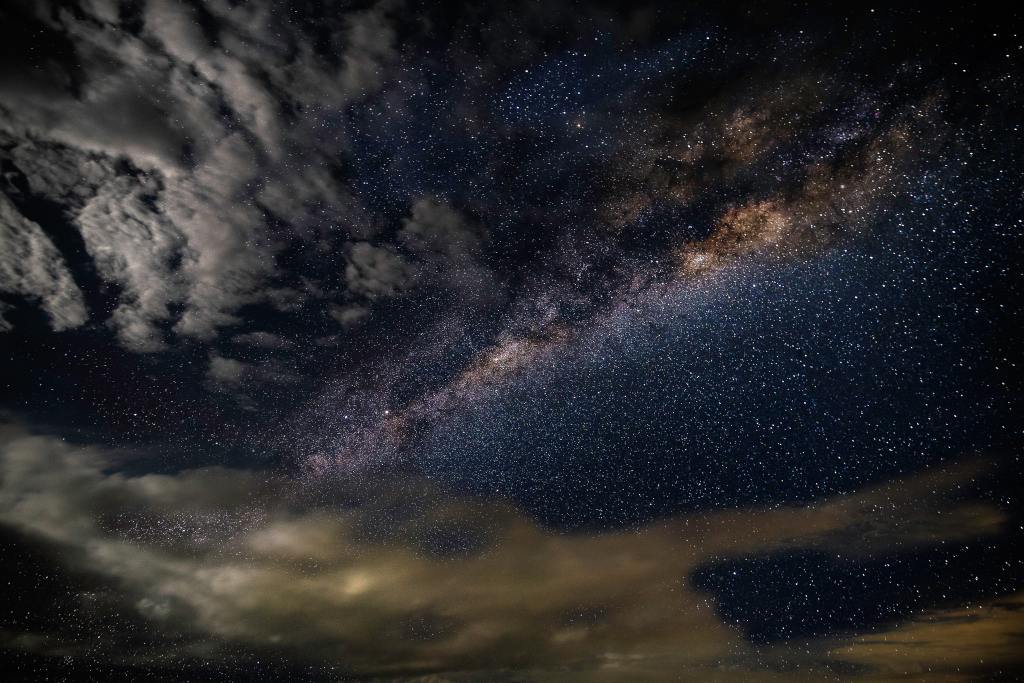
In the pursuit to understand Allāh’s dominion, he is reminded of the profound Hadith of the Prophet Mohammad sala Allāhu ‘alayhi wasalam which correlates the first heaven to the second to a ring thrown in the desert. Likewise, is the case up to the seventh, which correlates to a ring thrown in the desert to the Throne of Allāh. This highlights man’s limited knowledge and perception, imploring him to simply look at the unfathomable expanse of His creation, and urging him to submit to its Creator’s Might and Majesty:
“They have not shown Allāh His proper reverence—when on the Day of Judgment the ˹whole˺ earth will be in His Grip, and the heavens will be rolled up in His Right Hand. Glorified and Exalted is He above what they associate ˹with Him˺!”[10]
The Messenger sala Allāhu ‘alayhi wasalam also tells us that:
“The likeness of this world in comparison to the Hereafter is that of anyone of you dipping his finger into the sea: let him see what he brings forth.”[11]
And yet we find Him Subtle (al Latīf), caring for the ant and the duckling, listening to his whispers and endlessly showing him Mercy (al Rahīm):
“Indeed, ˹it is˺ We ˹Who˺ created humankind and ˹fully˺ know what their souls whisper to them, and We are closer to them than ˹their˺ jugular vein.”[12]
He provides man’s small mind with rationale behind injunctions and decrees and will love him, forgive him and remember him. He has favoured him with His guidance, from over the seventh heaven to the heart of his select servant. From it and through it he finds his way, on his short journey, back to the presence of his Creator when He decrees.
Does Allāh ‘Need’ to be Worshipped?
Worship is an essential aspect of man’s relationship with Allāh, and is not merely an obligation or a means to attain reward or avoid punishment. It is an acknowledgement of His deservedness to be worshipped. It is the connection between the transient creation and the Eternal Creator. Hence, it is the sustenance of our immortal soul, buying us Eternity.
The Fitrah, that inherent nature, compels man to recognize his role as a slave of the Creator. Worship is as much a choice as it is a universal inevitability, encompassing all aspects of existence.
Islam Harmonises Legislated (‘Shar’ī’) Worship with Universal (‘Kawnī’) Worship
The Muslim, as a submitter to Allāh’s Will – al-Istislām, willingly embraces the Shar’ī form of worship, aligning their lives with the Divine Commands.
He understands that his submission is in harmony with the universal reality that everything, willingly or unwillingly, submits to Allāh. From the atom to the cosmos, each obeys an order, functioning within precise and consistent laws. Likewise, man must breathe, eat, move, procreate and ultimately fit within His inescapable Divine Order, far beyond our control or influence.
His position as a creature within this symbiotic, harmonious and precise order means he is an inevitable slave to it, at the mercy of its Originator, Owner and Governor. Rationally, he is a slave of His, the Omnipotent Creator. He lives in a cosmos that worships Allāh and heads into an afterlife that worships Allāh:
“To Allāh ˹alone˺ bow down ˹in submission˺1 all those in the heavens and the earth—willingly or unwillingly—as do their shadows, morning and evening.”[13]
Everything in creation is circumstantially (al Hāl), perpetually in that state of prostration, Sujūd, humility, Khudū’ and submission Istislām to the His Power whether man accedes to this reality or deludes himself otherwise.
When he recites at least 17 times a day:
“You ˹alone˺ we worship and You ˹alone˺ we ask for help.”[14]
He acknowledges the universal imperatives and natural implications of the realities mentioned in the verses that precede:
“All praise is for Allāh, Lord of all worlds
The Most Compassionate, Most Merciful
Owner (or king) of the Day of Judgment…”[15]
Knowing that he is part of a universal system that inevitably submits to Allāh, the Muslim matches that reality with choice. His ‘Shar’ī’ choices are thus aligned and harmonised with the Kawnī realities of creation. His visible, ritualistic practices are but expressions of that submission. It is a choice for which he becomes closer to his Creator in this existence and the next. And it follows that to submit to the Greatest, is the greatest form of submission. This is why it is the most ‘liberating’ and fulfilling: to testify to the Truth, to be a witness to the Truth.
Man desires Islam as much as he desires truth and consistency. With Islam, his choices are true. He is content, reassured and relieved to have chosen what satisfies his firmest, inherent inclination:
“…Those who follow My guidance will not go astray and will not be miserable.”[16]
Worshipping the Almighty is the necessity of Creation to its Creator. It is not merely a human sentiment, but his link to, contact with and sustenance from the Creator and the foundation of existence. It is the integral basis of Creation, having been created to worship, or witness the Creator. It is the natural confession of creation towards its Creator, expressing its total reliance, acceptance and contentment with God.
Denial (Kufr) Collides Kawni with Shar’ee
The denier also inescapably submits to Allāh, and finds himself bound by His laws and the confines of His creation. But his wilful choices and statements contradict this reality. He thereby lives in a delusive, contradictory state. He lives by not an opinion, but a lie. The consequences of such denial are reflected in his overwhelming spiritual turmoil and existential discontentment:
“But if anyone turns away from My reminder, his life will be a dark and narrow one and on the Day of Rising We will gather him blind.”[17]
The crisis between choice and reality perilously suffocates him. He is exhausted and constricted. Though his life is futile, depressing and meaningless, death is still his detested cataclysm. He therefore neither truly lives nor contentedly dies:
“Whoever Allāh wills to guide, He opens their heart to Islam.1 But whoever He wills to leave astray, He makes their chest tight and constricted as if they were climbing up into the sky. This is how Allāh dooms those who disbelieve.”[18]
The Da’wah of Universal Realties
There are no ‘sincere’ atheists. ‘Sincerity’, according to the Oxford Dictionary is the quality of being free from pretence, deceit, or hypocrisy. Kufr can only exist by negating such a description. Thus, calling people to Islam is not to call them to embrace a new culture, but it is to invite them to be true to themselves, and to admit to their lie, dilemma, and conflict.
Consider Ibrahim ‘alayhi asalām’s call to the Nimrod, challenging him to change a universal ‘Kawnī’ reality the imposter, himself, experiences and is overpowered by on a daily basis, even as he claimed divinity:
“Abraham said, “My Lord is the One Who has power to give life and cause death.” He argued, “I too have the power to give life and cause death.” Abraham challenged ˹him˺, “Allāh causes the sun to rise from the east. So make it rise from the west.” And so the disbeliever was dumbstruck. And Allāh does not guide the wrongdoing people.”[19]
If you are God, or in contemporary language, if you are the ‘measure of all things’ or the ‘owner of your destiny’, attempt to change the sun’s course. Your inability not only proves that you are, in fact, a subject, overpowered by the effects of Divine Laws, but shows you recognise this truth as much as you recognise the rising sun.
He (or she) will assert unrestricted liberty, and unrestrained licence over his body and his conduct. He declares that nothing is beyond the realms of man. And yet, can this deluded individual prove his claim to absolute choice by conquering the indominable and unsolicited challenge of death?
“Wherever you may be, death will overcome you—even if you were in fortified towers…”[20]
He claims limitless access to resource and wealth. He is the owner of capital which ‘makes the world go round’. And yet, he is helpless when deprived of something as basic as water, like in August 2022, when droughts revealed an etched stone hidden in the river Elbe carved with a warning from 1616 that read: “If you see me, weep”:
Say, “Consider this: if your water were to sink ˹into the earth˺, then who ˹else˺ could bring you flowing water?”[21]
Tiny scientific discoveries and ‘blue-sky’ technological advancements have made him fantasise over his ability to dominate the world. And yet, he is challenged to bring about what are of the world’s most consistent phenomena, the night and day, if either were deprived:
“Ask ˹them, O Prophet˺, ‘Imagine if Allāh were to make the night perpetual for you until the Day of Judgment, which god other than Allāh could bring you sunlight? Will you not then listen?’
Ask ˹them also˺, ‘Imagine if Allāh were to make the day perpetual for you until the Day of Judgment, which god other than Allāh could bring you night to rest in? Will you not then see?’”[22]
Or even create something as abundant as a fly:
“O humanity! A lesson is set forth, so listen to it ˹carefully˺: those you invoke besides Allāh can never create ˹so much as˺ a fly, even if they ˹all˺ were to come together for that. And if a fly were to snatch anything away from them, they cannot ˹even˺ retrieve it from the fly. How powerless are those who invoke and those invoked!”[23]
The Sustainability of the Universe or its Destruction
The universe was created in wilful submission to its Creator, harmonising with the wilful submitter to his Creator:
“Then He turned towards the heaven when it was ˹still like˺ smoke, saying to it and to the earth, ‘Submit, willingly or unwillingly.’ They both responded, ‘We submit willingly.’”[24]
In the clash between the chosen realm (Shar’ī) and the universal realm (Kawnī), the denier of Allāh emerges as a destructive force, leading to the ultimate demise of the heavens and the earth. Kufr stands as a parasitic, leech-like, harbinger of destruction, and if alone, renders the universe unsustainable:
“…And if it were not for Allāh checking [some] people by means of others, the earth would have been corrupted, but Allāh is full of bounty to the worlds.”[25]
Thus, the finality of the heavens and earth and their ultimate demise comes when there remains only Kufr on earth: In the Hadith:
“The hour will not be established except upon the evillest”[26] and “the Hour (Resurrection) will not occur until ‘Allāh, Allāh’ is not said on earth.“[27]
The Mu’min represents Allāh’s mercy to creation, the purpose of creation, and the sustainability of the heavens and earth. He embodies its fresh air, its radiant warming sun, its bountiful rain and its flowing rivers. In stark contrast, the denier of Allāh embodies its fatal venom, its thick smog, its scorching desert, its freezing blizzards, its tumultuous storms, and its turbulent seas, wreaking havoc upon the world:
“And ˹remember˺ when they prayed, ‘O Allāh! If this is indeed the truth from You, then rain down stones upon us from the sky or overcome us with a painful punishment.’ But Allāh would never punish them while you ˹O Prophet˺ were in their midst. Nor would He ever punish them if they prayed for forgiveness.”[28]
Denying Allāh does not Liberate but Denigrates
Liberalism says it is about having choices. It is about the liberty to live without restrictive directives or theocratic regulation. Liberalism claims to have achieved emancipation from religious conformity or ‘worship’ and aristocratic privilege that are forced through the powers of government.
Though its founding fathers were staunchly opposed to Atheism, and firm advocates of social order, since the denial of God creates chaos and undermines such order, many of today’s liberals, in its name, have absconded God altogether, resulting in the chaotic outcome they had feared.
This is because servitude to a force of influence is an inescapable reality. Godly people’s demeanour, thoughts and actions are regulated by God and God, above Whom is none, is their purpose. From this perspective, one can validly argue that there is no such thing as “Atheism”. Man cannot but deify and worship, so long as within his cognition is the ability to discriminate between what is worthy and worthier. Whether his Creator, another thing idolised, be it wealth or material, or his own impulsive whim.
In fact, the word “worship” has its etymological roots in the Old English language. It can be traced back to the combination of two Old English words: “weorthscipe” and “worthscipe.”
The first part, “weorth” or “worth,” means “worth” or “value,” indicates the importance and significance placed on the object or being of worship. The second part, “scipe,” denotes “quality,” “state,” or “condition,” implying an act or state of showing reverence, honour, or devotion.
Therefore, when combined, “weorthscipe” or “worthscipe” conveys the idea of attributing worth or value to something or someone and demonstrating reverence or devotion accordingly. By such a definition, every man worships what he attributes the most worth and value to.
The Prophet sala Allāhu ‘alayhi wasalam said,
“May he be miserable, the worshipper of the dinar and dirham (the ‘pound’ and the ‘penny’), and the worshipper of the striped silk cloak. If he is given anything, he is satisfied; but if not, he is unsatisfied.”[29]
Thus, “Atheism”, is another form of idolatry that blind walks behind its idolised partisans in preference over one’s own axioms and rational inquiry. This may explain why the Qur’an more often deals with the question of idolatry, rather than that of ‘Atheism’, since the latter is but another name for the former.
If his futility of evading society’s guiding force, he is left to live life on a whim, following his appetites wherever they take him. Each whim is then an idol, an ‘ism’, forging as many ‘gods’ as there are whims, and each emerging to undermine the other. If it commands him to eat, he eats, to sleep, he sleeps, to procreate, he procreates, like cattle, with whatever is in front of him. But unlike cattle, he does so, possessing axioms, rationale and intelligence:
“Have you seen ˹O Prophet˺ the one who has taken their own whims as their god? Will you then be a keeper over them? Or do you think that most of them listen or understand? They are only like cattle—no, more than that, they are astray from the ˹Right˺ Way!”[30]
And yet, when sober and candid, he remains acutely aware of his endless, limitations and frailty. He knows, more than anyone that he is the least worthy of such deification. Thus, egotism and, self-idolisation is in fact self-abuse, that rather than liberates, restrains and enslaves man to what he knows to be inadequate and futile.
And as ‘worship’ is a universal reality, as we have explained, it follows that the more perfect the entity which one worships or submits to, the more perfect is one’s emancipation. And thus, to submit (al Istislaam) to the Greatest, above Whom there is none and the Perfect (al Salam), not marred by the limitations of man becomes the fullest form of emancipation. Complete submission to the unlimited, Infinite Perfect Creator provides Man with true freedom and liberation from the finite transient realm.
Concluding Note
In a world of denial and distorted beliefs, it is crucial to articulate the true nature of Allāh, the Almighty. The term “Allāh” emphasizes His uniqueness and exclusivity, distinguishing Him from everything else within creation. Allāh is the First and the Last, the Creator, and the Compeller, transcending the seen and unseen, with limitless mercy and compassion.
Recognising and bearing witness to the oneness of Allāh is to acknowledge that everything in the universe is under His Control and subject to His Power. The reduction or distortion of God’s attributes undermines His perfection and ultimately denies His existence. To attribute limitation to God, is to immediately be ignorant of Him.
Through His Perfect Names and Attributes, Allāh manifests His Infinite Wisdom, Power, and Grace. His creation serves as signs and impacts of His Perfect Names and Attributes. Worshiping Allāh is not only an obligation but a natural acknowledgment of His deservingness and the recognition that everything willingly or unwillingly submits to His Power. Denying Allāh’s existence leads to living in defiance and delusion, detached from the inherent truth embedded in our hearts and the world around us.
Denying Allāh not only fails to liberate individuals from perceived religious constraints but also devalues their inherent worth and purpose. In fact, atheism changes Man, the Viceregent of God into less than a caged beast. Atheism denies the fundamental truth that humans are created with a purpose and possess inherent dignity. The fact everything ‘human’ becomes subjective and arbitrary means ‘humanism’ cannot present a viable moral and ethical framework, as it too, is arbitrary.
Ultimately, denying Allāh denies the opportunity for individuals to connect with their Creator, find true fulfilment, and experience the purpose and meaning for which they have been created. A meaningless life is akin to no life at all, and the fallen modern world frantically needs those who salvage it from the depths of damnation and the yoke of nihilism to their ultimate purpose and liberation.
References:
Thanks goes to my esteemed teacher Dr. Najmuddin Hasan for helping formulate this article and for his invaluable inputs, insights and corrections.
[1] Qur’an 59:22-24
[2] Qur’an 6:162-163
[3] Qur’an 6:164
[4] Qur’an 23:90-91
[5] Qur’an 7:172
[6] Qur’an 57:3
[7] Qur’an 51:20-21
[8] Qur’an 21:18
[9] Qur’an 55:26-27
[10] Qur’an 39:67
[11] Muslim on the authority of Al-Mustaurad b. Shaddad rady Allāhu ‘anh
[12] Qur’an 50:16
[13] Qur’an 13:15
[14] Qur’an 1:5
[15] Qur’an 1:2-4
[16] Qur’an 20:123
[17] Qur’an 20:124
[18] Qur’an 6:125
[19] Qur’an 2:258
[20] Qur’an 4:78
[21] Qur’an 67:30
[22] Qur’an 28-71-72
[23] Qur’an 22:73
[24] Qur’an 41:11
[25] Qur’an 2:251
[26] Muslim on the authority of ‘Abdullah b. Mas’oud rady Allāhu ‘anh
[27] Muslim on the authority of Anas b. Malik rady Allāhu ‘anh
[28] Qur’an 8:32-33
[29] Bukhari on the authority of Abu Hurairah rady Allāhu ‘anh
[30] Qur’an 25:43-44

 SarimBlog